Liberal Forum
Archive
‹
Political Chat Rooms
‹
No Holds Barred Political Forum
‹
CARTER GREW THE ECONOMY MUCH BETTER THAN REAGAN
CARTER GREW THE ECONOMY MUCH BETTER THAN REAGAN

By Cannonpointer
16 Feb 2014 2:56 am in No Holds Barred Political Forum

17 Feb 2014 5:00 pm

Very good post.Silverfox » 17 Feb 2014 3:27 pm » wrote:Back to Reagan just for a moment.
A few thoughts occur to me that haven't been discussed.
First, unemployment. Lots of numbers floating about but little comment on the fact that Reagan actually changed the way unemployment was counted (in a way that still helps out today's President, ironically).
Second, stagflation. Volcker (and Carter) can be argued to have most of the credit for solving that, by limiting the money supply and easing the pricing of oil. This is if you accept that it was driven by oil price hikes and an expansionary monetary policy under Nixon, which many do.
Third, Reagan benefited from a weak dollar (I recall getting two dollars for a pound in the 80s) and an oil glut (and reduced oil prices - under $30 a barrel).
Fourth, far from a reduced government, Reagan ended up with more government employees. The military spending increases (up 60%?) are indeed pumped into the economy via people's salaries.
Fifth, if this was all a necessary expenditure to end the Soviet Union, why was Reagan so keen on holding talks of disarmament and detente?
This is a guy who won the presidency with 50.7% of the vote. After he had struck a deal with the Iranians NOT to release hostages under Carter - offering arms to pay for their help. Sure enough, as soon as he got in - hey presto - hostages released!
He certainly left a legacy. A bit like Thatcher did over here. And people feel strongly about him, one way or the other.
I do think, however, that he failed to walk on water. He did some good things and some bad things. Mostly, I think he was a force for the worse and I track the death of the USA I remember being so fond of as a child, growing up, to him.
YMMV.
Reagan was a good joke quipper, you gotta give him that.

17 Feb 2014 5:01 pm

****. You're only "charitable" with other people's money.skews13 » 17 Feb 2014 4:51 pm » wrote:I'm more than happy to donate a couple of bucks to this worthy endeavor. I'm charitable like that.
17 Feb 2014 5:11 pm

17 Feb 2014 5:42 pm
Sorry, you lose. If you say to someone "I read such and such in the paper," does that make you the source? No. The paper is the source. About is not a primary source any more than wiki is. And the funny thing about wiki is that most of its articles are sourced with a zillion footnotes so you can go right to the primary sources, yet dumbasses on this forum, not smart enough to understand that, put them down. You think maybe the WSJ runs ads for questionable stuff? Does that content screw the stuff you like on their editorial page? Of course not. By the same token, all that stuff you mentioned that About carries has nothing to do with other stuff there. Your argument has no merit.RichClem » 16 Feb 2014 6:09 am » wrote:
Hilarious that the psychotic is standing by this stunningly stupid claim.
But he must have an absolutely impeccable source, having rejected every one of mine!
about.com

Let's see more of the wisdom and subject matter carried by his source. CP would never, EVER cite a questionable source!
Wow, they have a candy "expert!"
And an expert on grandfathers!
Then they must be experts on Economics and history, too!
I love psychotic moonbat humor!

17 Feb 2014 5:50 pm

I officially incorporate this great post into my own response to Miss Economist.Silverfox » 17 Feb 2014 3:27 pm » wrote:Back to Reagan just for a moment.
A few thoughts occur to me that haven't been discussed.
First, unemployment. Lots of numbers floating about but little comment on the fact that Reagan actually changed the way unemployment was counted (in a way that still helps out today's President, ironically).
Second, stagflation. Volcker (and Carter) can be argued to have most of the credit for solving that, by limiting the money supply and easing the pricing of oil. This is if you accept that it was driven by oil price hikes and an expansionary monetary policy under Nixon, which many do.
Third, Reagan benefited from a weak dollar (I recall getting two dollars for a pound in the 80s) and an oil glut (and reduced oil prices - under $30 a barrel).
Fourth, far from a reduced government, Reagan ended up with more government employees. The military spending increases (up 60%?) are indeed pumped into the economy via people's salaries.
Fifth, if this was all a necessary expenditure to end the Soviet Union, why was Reagan so keen on holding talks of disarmament and detente?
This is a guy who won the presidency with 50.7% of the vote. After he had struck a deal with the Iranians NOT to release hostages under Carter - offering arms to pay for their help. Sure enough, as soon as he got in - hey presto - hostages released!
He certainly left a legacy. A bit like Thatcher did over here. And people feel strongly about him, one way or the other.
I do think, however, that he failed to walk on water. He did some good things and some bad things. Mostly, I think he was a force for the worse and I track the death of the USA I remember being so fond of as a child, growing up, to him.
YMMV.

When you complain, ur friends roll their eyes and ur enemies rejoice
"Because I SAY I am" is a todler's tantrum, not "science"
You cannot betray me - only yourself, to me.
Who cuts off your dick is not a friend
An opinion you won't defend is not your own
Humanity's Law of the Jungle: Survival NOT of the fittest, but of the tribe
When peeing in the pool, stand on the edge
If gender is not sex, why should a gender claim change what sex you shower with?
"Because I SAY I am" is a todler's tantrum, not "science"
You cannot betray me - only yourself, to me.
Who cuts off your dick is not a friend
An opinion you won't defend is not your own
Humanity's Law of the Jungle: Survival NOT of the fittest, but of the tribe
When peeing in the pool, stand on the edge
If gender is not sex, why should a gender claim change what sex you shower with?
17 Feb 2014 5:53 pm
As Silver Fox reminded us, Reagan was the guy who changed how unemployment numbers (and vegetables) were counted.danobivins » 17 Feb 2014 5:11 pm » wrote:Wasn't the unemployment rate over 10% under reagan?
Nothing to brag abt.
He wanted to count catsup on a hamburger as a vegetable in school lunches. His buddies in the military industrial complex could afford artichokes and Brussels sprouts - but **** America's school children. For them, CATSUP was a veggie.
The man was a monster.
When you complain, ur friends roll their eyes and ur enemies rejoice
"Because I SAY I am" is a todler's tantrum, not "science"
You cannot betray me - only yourself, to me.
Who cuts off your dick is not a friend
An opinion you won't defend is not your own
Humanity's Law of the Jungle: Survival NOT of the fittest, but of the tribe
When peeing in the pool, stand on the edge
If gender is not sex, why should a gender claim change what sex you shower with?
"Because I SAY I am" is a todler's tantrum, not "science"
You cannot betray me - only yourself, to me.
Who cuts off your dick is not a friend
An opinion you won't defend is not your own
Humanity's Law of the Jungle: Survival NOT of the fittest, but of the tribe
When peeing in the pool, stand on the edge
If gender is not sex, why should a gender claim change what sex you shower with?

17 Feb 2014 5:57 pm
I seeRichClem » 17 Feb 2014 6:53 am » wrote:Yes, the graph is incorrect.
And I guess this one is as well
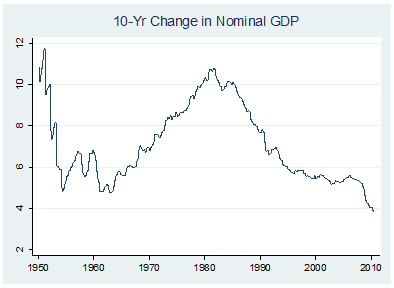
This is nominal GDP growth on a ten-year rolling average – for people who do not think that what the economy is doing right now today is necessarily the best way to gauge its condition.
Note how growth peaks around 1980, rebounds a tad around '82, then goes downhill, pretty steadily, ever since. This is a nice little picture of Reagan's legacy.
17 Feb 2014 6:19 pm
I'm sorry, can you tell us all why you're talking Nominal GDP, and what Reagan policies lead you to this claim that he is responsible for GDP ever since 1980?Spirit of Molly » 17 Feb 2014 5:57 pm » wrote:Note how growth peaks around 1980, rebounds a tad around '82, then goes downhill, pretty steadily, ever since. This is a nice little picture of Reagan's legacy.
17 Feb 2014 6:22 pm
Can you link is to him making Reagan responsible for 80-82?golfboy » 17 Feb 2014 6:19 pm » wrote: I'm sorry, can you tell us all why you're talking Nominal GDP, and what Reagan policies lead you to this claim that he is responsible for GDP ever since 1980?
Also, if he had shown a graph that ran from 1968 to 1990, and used it to illuminate Reagan's record, would you have pretended that he was putting 1968 on Reagan?
One more thing - how long have you been a boy toucher?
When you complain, ur friends roll their eyes and ur enemies rejoice
"Because I SAY I am" is a todler's tantrum, not "science"
You cannot betray me - only yourself, to me.
Who cuts off your dick is not a friend
An opinion you won't defend is not your own
Humanity's Law of the Jungle: Survival NOT of the fittest, but of the tribe
When peeing in the pool, stand on the edge
If gender is not sex, why should a gender claim change what sex you shower with?
"Because I SAY I am" is a todler's tantrum, not "science"
You cannot betray me - only yourself, to me.
Who cuts off your dick is not a friend
An opinion you won't defend is not your own
Humanity's Law of the Jungle: Survival NOT of the fittest, but of the tribe
When peeing in the pool, stand on the edge
If gender is not sex, why should a gender claim change what sex you shower with?
17 Feb 2014 6:43 pm
You lose. I was wondering how long it was going to take you to admit your failure.Cannonpointer » 17 Feb 2014 6:22 pm » wrote: Can you link is to him making Reagan responsible for 80-82?
Also, if he had shown a graph that ran from 1968 to 1990, and used it to illuminate Reagan's record, would you have pretended that he was putting 1968 on Reagan?
One more thing - how long have you been a boy toucher?
17 Feb 2014 6:46 pm
Obviously, Reagan was not president in 1980, when GDP growth peaked. His policies did not take effect until around '82, where it looks like the growth rate drops sharply, rebounds a bit, then goes into decline. Reagan claimed he would make things better. "Morning in America" looks more like a swift march toward darkness.golfboy » 17 Feb 2014 6:19 pm » wrote: I'm sorry, can you tell us all why you're talking Nominal GDP, and what Reagan policies lead you to this claim that he is responsible for GDP ever since 1980?
17 Feb 2014 6:50 pm
I didn't ask you to restate your prior post, I asked why you used nominal gdp instead of real, and what policies lead you to claim Reagan was responsible for the 30 year trend on your chart.Spirit of Molly » 17 Feb 2014 6:46 pm » wrote: Obviously, Reagan was not president in 1980, when GDP growth peaked. His policies did not take effect until around '82, where it looks like the growth rate drops sharply, rebounds a bit, then goes into decline. Reagan claimed he would make things better. "Morning in America" looks more like a swift march toward darkness.

17 Feb 2014 8:00 pm
Um, sure...Cannonpointer » 17 Feb 2014 4:41 pm » wrote:
Okay, so your argument, as I see it, is that Reagan merely enriched the corporatocracy with all of his borrowing from the unborn - by-passing the hoi palloi (Ike warned us about this scoundrel, did he not?).
Yeah. It got better because it got better. There weren't any underlying factors that cause the improvement of the economy. The economy wasn't experiencing and frictional or structural unemployment. The issue with the economy derived mainly from a monetary perspective.It got better because it got better?
No, but now that you've asked, you should know that when people refer to population growth in terms of labour, they are usually referring to something called 'non institutional civilian population.' This involves individuals who are above the age of 16 (working aged people), living in the United States, who are not institutionalized (criminal, mental, or other type of facility) and who are also not on active duty in the military.Does every new baby need a job?
So, yes, people above the age of 16 generally need a job. And if there are more people entering the non-institutional civilian population than there are jobs being created, that is not a good thing.
Feel free to spot the amnesty trend...Did his amnesty, which brought millions out of the underground economy and onto the official roles, have any effect that you are failing to consider?

Hm, maybe. I'm not ruling it out. Part-Time is in Bold BTWDid his tax incentives to hire part timers have any effect that you are failing to consider?

Reagan removed the price controls implemented by the Nixon administration.I'm not really seeing much a defense of Reagan. What policies of his do you argue had anything to do with this alleged economic recovery?
That's about it. Reagan was more focused with fighting inflation, if he wasn't fighting the Soviet Union.
Who is calling the Federal Reserve a criminal enterprise?I do not have your education in economics. On the other hand, I have never met a professional economist who would openly declare the Federal Reserve to be a criminal enterprise - so economists are about as high in my esteem, ultimately, as climatologists. Both are more educated than I and more able than I to sling official slogans and make arguments that sound truthy, but neither can ultimately be trusted not to be spinning ****.
Looking at the economy entails looking more at GDP. I don't just look at the unemployment rate. I look at the people who are in the labour force, as well as the people who have left it. I look at the types of jobs created. I look at the type of jobs lost. I look at industrial production. I look at everything, or, at least the issues that are relevant. During the 1980's, the problems with the economy were high unemployment and high inflation.Let me just give you an example. You say "the economy" experienced "better growth." Okay. But do you and I REALLY even share a common meaning of the phrase, "the economy?" When I see "the economy" spoken of in the media, they are invariably talking about the stock market. And if you REALLY listen, when they talk about how "the economy" is doing, they are REALLY talking - very specifically - about how rich people are doing. They even go so far as to declare the economy "recovered" when that "recovery" is admittedly "jobless."
The reason why the economy was bad under Carter (and the 1970's) was because there were more than 6 financial quarters of shrinking GDP, while inflation was average 7 - 9% annually, which shouldn't happen (not to say that it shouldn't happen, but it's unusual). The unusual part is when the economy experiences high unemployment and high inflation. High unemployment is a cure for high inflation, as slow growth in the economy reduces demand for goods and services to keep prices from rising. As a result, businesses are not as profitable, hence, they lay workers off and they buy less good and services.
This didn't happen at all during the 1970's, hence, why it's called Stagflation. And also, why the reforms of the 1980's took place.
The entire purpose of stimulus (fiscal stimulus anyway) is to get money to flow throughout the economy. None of this military spending made its way into the economy. It would have been no different if the Government decided to purchase 1 million shares of Berkshire Hathaway. All they would have been doing was enriching a few shareholders. And sure, that money would have also flow through the economy, but the multiplier effect would have been near nil...Reagan borrowed, every year, close to what Carter borrowed in four. SOME of that money to Lockheed Martin, Boeing, Northrup, General Dynamics, etc., found its way into the economy via wages, no? Reagan did not yet destroy EVERY union - there were still some people making good wages off his military bloat.
17 Feb 2014 8:35 pm
What change are you referring to? The only change to the BLS methodology since 1940 was in 1994. Prior to 1994, the BLS use to ask people if they searched for work recently. If people give the BLS one of five reasons why they haven't searched for work within the last 4 weeks, they were assumed to have given up, even though they were not asked when they last looked.Silverfox » 17 Feb 2014 3:27 pm » wrote:Back to Reagan just for a moment.
A few thoughts occur to me that haven't been discussed.
First, unemployment. Lots of numbers floating about but little comment on the fact that Reagan actually changed the way unemployment was counted (in a way that still helps out today's President, ironically).
In 1994, there was greater specificity involved in the methodology, which ultimately cut the amount of discouraged workers in half. That happened during the Clinton administration, not the Reagan Administration. You can read all about it here:
http://www.bls.gov/opub/mlr/1995/10/art3full.pdf
I've noticed we've been having a bit a trouble determining when each administration starts and where it ends, but it's a bit of a stretch to assume Reagan had anything to do with this.
The expansion of the monetary didn't start under Nixon. It started under LBJ and the guns and butter administration. To pay for all of their great social reforms, they started printing dollars at an alarming rate. This caused people to redeem their federal reserve notes for gold at an increasing rate, which was depleting the overall gold reserves held by the United States.Second, stagflation. Volcker (and Carter) can be argued to have most of the credit for solving that, by limiting the money supply and easing the pricing of oil. This is if you accept that it was driven by oil price hikes and an expansionary monetary policy under Nixon, which many do.
The monetary base was essentially stable before the 1960's.

To prevent this from happening, the Nixon suspended the Bretton Wood's System, and eventually resulted in Americas' first default.
While your anecdotal claims does not interest me, what weak dollar? The Dollar Index (DXY) peaked at 164.74 in 1984. Today, it's barely half of that.Third, Reagan benefited from a weak dollar (I recall getting two dollars for a pound in the 80s) and an oil glut (and reduced oil prices - under $30 a barrel).
Just so you know, the Dollar is weighed against a basket of major currencies (Yen, Pound, Euro, Franc, Canadian Dollar, Krona). You cannot determine the strength of it by just pairing it with one currency. All you've done was determine the strength of the dollar relative to the Pound. That's meaningless information.
I've already shown that most of the shortfalls in GDP was in government spending (decreased as a percentage of GDP). Whatever was pumped into the economy, it wasn't in the form of federal salaries.Fourth, far from a reduced government, Reagan ended up with more government employees. The military spending increases (up 60%?) are indeed pumped into the economy via people's salaries.
This this particularly important because Government spending has the multiplier of x2, while PCE has only a x1 Multiplier. Meaning, when the government pays the salaries of its workers (as well as when these employees spend their paycheck).
Who cares?Fifth, if this was all a necessary expenditure to end the Soviet Union, why was Reagan so keen on holding talks of disarmament and detente?
Political nonsense that doesn't interest me.This is a guy who won the p...
Snip

17 Feb 2014 11:09 pm

It's really common sense Cannon. Here are the numbers.Cannonpointer » 16 Feb 2014 1:00 pm » wrote:
There's a remedy for that sideswipe to the OP. Present alternative numbers or an alternative explanation for those numbers. Just remember to incorporate Post # 4 in your critique, since it goes on to break down raw debt vs. debt to GDP ratio - reagan loses either way, of course - but the second way accounts for reagan's failure to keep the dollar sound (inflation).
The numbers speak against the conservative MSM narrative. I have clearly demonstrated that. If you can save the narrative, then by all means, do get busy. Hold your end, son.
http://useconomy.about.com/od/GDP-by-Ye ... istory.htm
http://www.multpl.com/inflation/table
Under the usual economic calculations, inflation is included in GDP. If prices go up then the value of what we produce goes up, even if nothing additional is produced. There wasn't a single year during Carter's administration where inflation didn't outpace growth. This is why Reagan is remembered more fondly than the the Peanut Farmer. People's account balances grew faster than the **** they were were buying.
18 Feb 2014 12:32 am
That would be me, and anyone else who has read our founding documents and understands the purpose of Article 1, Sec. 10 of the U.S. Constitution. Now, before you explain how a metal based monetary system won't allow growth, let me say this: My argument is not against an elastic money supply. My argument is against a private corporation with secret ownership that never gets audited having a franchise on issuing currency. That's a RICO violation on wheels.AmazonTania » 17 Feb 2014 8:00 pm » wrote: Who is calling the Federal Reserve a criminal enterprise?
Your school has omitted this from your education and given you pure **** to chew You're probably under the impression that the federal reserve bank is a government agency. It isn't.
Funny you should mention that. Isn't it axiomatic that inflation, unemployment and interest rates are inter-related, and any time that any two are in double digits the other will be automatically driven into single digits? They do teach that, do they not? Yet Carter had all three in double digits, didn't he? You don't suppose an "invisible hand" might have had a finger on the scale?AmazonTania » 17 Feb 2014 8:00 pm » wrote: Looking at the economy entails looking more at GDP. I don't just look at the unemployment rate. I look at the people who are in the labour force, as well as the people who have left it. I look at the types of jobs created. I look at the type of jobs lost. I look at industrial production. I look at everything, or, at least the issues that are relevant. During the 1980's, the problems with the economy were high unemployment and high inflation.
The reason why the economy was bad under Carter (and the 1970's) was because there were more than 6 financial quarters of shrinking GDP, while inflation was average 7 - 9% annually, which shouldn't happen (not to say that it shouldn't happen, but it's unusual). The unusual part is when the economy experiences high unemployment and high inflation. High unemployment is a cure for high inflation, as slow growth in the economy reduces demand for goods and services to keep prices from rising. As a result, businesses are not as profitable, hence, they lay workers off and they buy less good and services.
That's the purpose of stimulus according to the left. According to neocons, it's to take money directly out of the treasury and transfer it immediately into the pockets of the people who need it least. The repukes - in congress and on this board - had a CONNIPTION about unemployment bennies - the universally agreed most stimulative money that the government can possibly inject into the economy. Then they went after SNAP - again, very stimulative. But Goldman Sach's perfectly "legal" insider franchise on trading Treasury Bonds? They defend it.AmazonTania » 17 Feb 2014 8:00 pm » wrote:The entire purpose of stimulus (fiscal stimulus anyway) is to get money to flow throughout the economy. None of this military spending made its way into the economy. It would have been no different if the Government decided to purchase 1 million shares of Berkshire Hathaway. All they would have been doing was enriching a few shareholders. And sure, that money would have also flow through the economy, but the multiplier effect would have been near nil...
One more thing I would like to ask you about. Isn't it true that, more and more as reaganomics continues, a big piece of our so-called "economy" is nothing more than two vampires trading debt instruments at great profit without a customer or a service or a product - just "making" MONEY? And when the "economy" is basically witchcraft, how the **** can we have a meaningful discussion about it? Again, I put economists with climatologists: two camps that peddle likely stories and nicely cooked narratives which are careful to protect important agendas - in the case of economists, pretending the federal reserve is not a scam on the public (As if borrowing every dollar into circulation from people who have nothing but a magical dollar-issuing franchise is somehow "good" for our country).
When you complain, ur friends roll their eyes and ur enemies rejoice
"Because I SAY I am" is a todler's tantrum, not "science"
You cannot betray me - only yourself, to me.
Who cuts off your dick is not a friend
An opinion you won't defend is not your own
Humanity's Law of the Jungle: Survival NOT of the fittest, but of the tribe
When peeing in the pool, stand on the edge
If gender is not sex, why should a gender claim change what sex you shower with?
"Because I SAY I am" is a todler's tantrum, not "science"
You cannot betray me - only yourself, to me.
Who cuts off your dick is not a friend
An opinion you won't defend is not your own
Humanity's Law of the Jungle: Survival NOT of the fittest, but of the tribe
When peeing in the pool, stand on the edge
If gender is not sex, why should a gender claim change what sex you shower with?

18 Feb 2014 12:41 am

Cannon Donahue up here I got your back.Cannonpointer » 17 Feb 2014 3:46 pm » wrote:
My OP offered to argue EITHER, because I know how dishonest you are.
YOU CHOOSE.
Do you want the set that turns the economy over to reagan at -.002 growth (basically, a flat economy), or do you want the one that gives Carter a lower OVERALL score?
You cannot have both, and I will argue neither with you until you agree to stick with one and only one throughout the argument.
18 Feb 2014 12:42 am
Your first link verifies every critique I made of reagan - he looks worse than Carter, ESPECIALLY when you take into account that Carter droped our debt to GDP ratio instead of hiking it as reagan did.tharock220 » 17 Feb 2014 11:09 pm » wrote:
It's really common sense Cannon. Here are the numbers.
http://useconomy.about.com/od/GDP-by-Ye ... istory.htm
http://www.multpl.com/inflation/table
Under the usual economic calculations, inflation is included in GDP. If prices go up then the value of what we produce goes up, even if nothing additional is produced. There wasn't a single year during Carter's administration where inflation didn't outpace growth. This is why Reagan is remembered more fondly than the the Peanut Farmer. People's account balances grew faster than the **** they were were buying.
Your second link, while I ACCEPT it, confuses me. How can a baby hating big borrower like reagan , who eats tomorrow's baby food today and peddles ketchup as a vegetable in school lunches - how can a guy like that reduce inflation, when he borrowed so much **** money that it amounted to almost two thirds of the entire economy he inherited? He inherited what - a 3.2 trillion dollar economy? Then he borrows 1.8 trillion?
He was the first guy since WWII who did not drive the debt to gdp ratio down. Only one president has done so since, and that was Billy Clinton - twice.
How can you defend a big spending, big borrowing liberal who federalized education, against a small borrowing, government shrinking peanut farmer who committed adultery, but only in his heart?
When you complain, ur friends roll their eyes and ur enemies rejoice
"Because I SAY I am" is a todler's tantrum, not "science"
You cannot betray me - only yourself, to me.
Who cuts off your dick is not a friend
An opinion you won't defend is not your own
Humanity's Law of the Jungle: Survival NOT of the fittest, but of the tribe
When peeing in the pool, stand on the edge
If gender is not sex, why should a gender claim change what sex you shower with?
"Because I SAY I am" is a todler's tantrum, not "science"
You cannot betray me - only yourself, to me.
Who cuts off your dick is not a friend
An opinion you won't defend is not your own
Humanity's Law of the Jungle: Survival NOT of the fittest, but of the tribe
When peeing in the pool, stand on the edge
If gender is not sex, why should a gender claim change what sex you shower with?
18 Feb 2014 12:43 am
Hell to the yeah my nigga.onlyaladd » 18 Feb 2014 12:41 am » wrote: Cannon Donahue up here I got your back.
When you complain, ur friends roll their eyes and ur enemies rejoice
"Because I SAY I am" is a todler's tantrum, not "science"
You cannot betray me - only yourself, to me.
Who cuts off your dick is not a friend
An opinion you won't defend is not your own
Humanity's Law of the Jungle: Survival NOT of the fittest, but of the tribe
When peeing in the pool, stand on the edge
If gender is not sex, why should a gender claim change what sex you shower with?
"Because I SAY I am" is a todler's tantrum, not "science"
You cannot betray me - only yourself, to me.
Who cuts off your dick is not a friend
An opinion you won't defend is not your own
Humanity's Law of the Jungle: Survival NOT of the fittest, but of the tribe
When peeing in the pool, stand on the edge
If gender is not sex, why should a gender claim change what sex you shower with?

18 Feb 2014 4:34 am
You don't need to change the entire methodology to change the result. I believe the concept of "discouraged" workers was introduced under Reagan. The inclusion of the military was under Reagan. The number of hours work required before someone is deemed "fully employed" was reduced. There were also changes to the CPS calculations in 82, 83, 85 and 86.AmazonTania » 17 Feb 2014 8:35 pm » wrote:
What change are you referring to? The only change to the BLS methodology since 1940 was in 1994. Prior to 1994, the BLS use to ask people if they searched for work recently. If people give the BLS one of five reasons why they haven't searched for work within the last 4 weeks, they were assumed to have given up, even though they were not asked when they last looked.
In 1994, there was greater specificity involved in the methodology, which ultimately cut the amount of discouraged workers in half. That happened during the Clinton administration, not the Reagan Administration. You can read all about it here:
http://www.bls.gov/opub/mlr/1995/10/art3full.pdf
I've noticed we've been having a bit a trouble determining when each administration starts and where it ends, but it's a bit of a stretch to assume Reagan had anything to do with this.
Does any of that change what Volcker and Carter did and how it benefited Reagan? You know - the thing we were discussing.AmazonTania » 17 Feb 2014 8:35 pm » wrote: The expansion of the monetary didn't start under Nixon. It started under LBJ and the guns and butter administration. To pay for all of their great social reforms, they started printing dollars at an alarming rate. This caused people to redeem their federal reserve notes for gold at an increasing rate, which was depleting the overall gold reserves held by the United States.
The monetary base was essentially stable before the 1960's.
To prevent this from happening, the Nixon suspended the Bretton Wood's System, and eventually resulted in Americas' first default.
Yes, the dollar became much stronger under Reagan, having spent the previous decade weakening (so he inherited a weak dollar, as I said). In fact, the strengthening of the dollar became a problem - hence the Plaza Accord. Because he ran up high deficits (due to the military buildup and tax cuts) and because of what Volcker was doing, interest rates were high. The value of the dollar rose accordingly.AmazonTania » 17 Feb 2014 8:35 pm » wrote: While your anecdotal claims does not interest me, what weak dollar? The Dollar Index (DXY) peaked at 164.74 in 1984. Today, it's barely half of that.
Just so you know, the Dollar is weighed against a basket of major currencies (Yen, Pound, Euro, Franc, Canadian Dollar, Krona). You cannot determine the strength of it by just pairing it with one currency. All you've done was determine the strength of the dollar relative to the Pound. That's meaningless information.
Check the DXY when he came to power. http://www.tradingeconomics.com/charts/united-states-currency.png?s=dxy&d1=19700101&d2=19891231

You appear very confident in that multiplier. It seems high to me. Don't they vary depending on circumstances (e.g recession vs expansion) and on the type of investment? Either way, there is a lot of debate around the multiplier for military spending but few would argue that it has no impact on the economy, as you appear to be doing.AmazonTania » 17 Feb 2014 8:35 pm » wrote: I've already shown that most of the shortfalls in GDP was in government spending (decreased as a percentage of GDP). Whatever was pumped into the economy, it wasn't in the form of federal salaries.
This this particularly important because Government spending has the multiplier of x2, while PCE has only a x1 Multiplier. Meaning, when the government pays the salaries of its workers (as well as when these employees spend their paycheck).
It isn't about federal salaries. That money has to go somewhere. It gets spent. Businesses supply the military and other businesses supply them. These businesses employ people. They also buy raw materials. They develop technologies and do research. There is a whole industrial complex that wants feeding. Does this industry have no impact on the economy? Please explain why.
Who is online
In total there are 9653 users online :: 11 registered, 14 bots, and 9628 guests
Registered users: Johnny You, *Roshambo, Blackvegetable, RebelGator, FJB, Beekeeper, jerra b, Deezer Shoove, nefarious101, sole, Huey
Bots: Not, Pinterest, LCC, proximic, Baiduspider, ADmantX, curl/7, NING, bingbot, CriteoBot, Mediapartners-Google, Applebot, Googlebot, facebookexternalhit