Liberal Forum
Archive
‹
Political Chat Rooms
‹
No Holds Barred Political Forum
‹
CARTER GREW THE ECONOMY MUCH BETTER THAN REAGAN
CARTER GREW THE ECONOMY MUCH BETTER THAN REAGAN

By Cannonpointer
16 Feb 2014 2:56 am in No Holds Barred Political Forum
16 Feb 2014 1:39 pm

A FULLY BLOWN anecdote - not jut an IMPLIED anecdote! His courage is GROWING!crimsongulf » 16 Feb 2014 12:04 pm » wrote:
I was in the adult world under both of them, I will stick with Reagan for results. Carter was stuck with the title of most incompetent POTUS ever, till now.
When you complain, ur friends roll their eyes and ur enemies rejoice
"Because I SAY I am" is a todler's tantrum, not "science"
You cannot betray me - only yourself, to me.
Who cuts off your dick is not a friend
An opinion you won't defend is not your own
Humanity's Law of the Jungle: Survival NOT of the fittest, but of the tribe
When peeing in the pool, stand on the edge
If gender is not sex, why should a gender claim change what sex you shower with?
"Because I SAY I am" is a todler's tantrum, not "science"
You cannot betray me - only yourself, to me.
Who cuts off your dick is not a friend
An opinion you won't defend is not your own
Humanity's Law of the Jungle: Survival NOT of the fittest, but of the tribe
When peeing in the pool, stand on the edge
If gender is not sex, why should a gender claim change what sex you shower with?
16 Feb 2014 1:41 pm
No, his 8th grade grammar teacher. His math is right, the way HE set it up - just not the way I set it up. He misread the words. He doesn't understand prepositions. Word problems start with words and work on to math. He bungled the words, then got the math right (from a bungled beginning).greatnpowerfuloz » 16 Feb 2014 12:08 pm » wrote:
Which is not the way cannonpointer presented it. Had you read it and comprehended what he was saying, you would realize that he never said that Carter increased the economy BY 154%. You would have seen that he said Carter increased the economy TO 154%.
If you're still confused about the difference between the two, you might need to give your 3rd grade math teacher a ring.
When you complain, ur friends roll their eyes and ur enemies rejoice
"Because I SAY I am" is a todler's tantrum, not "science"
You cannot betray me - only yourself, to me.
Who cuts off your dick is not a friend
An opinion you won't defend is not your own
Humanity's Law of the Jungle: Survival NOT of the fittest, but of the tribe
When peeing in the pool, stand on the edge
If gender is not sex, why should a gender claim change what sex you shower with?
"Because I SAY I am" is a todler's tantrum, not "science"
You cannot betray me - only yourself, to me.
Who cuts off your dick is not a friend
An opinion you won't defend is not your own
Humanity's Law of the Jungle: Survival NOT of the fittest, but of the tribe
When peeing in the pool, stand on the edge
If gender is not sex, why should a gender claim change what sex you shower with?

16 Feb 2014 1:41 pm

Sorry man, but in order for your chart to be true, than it is me using the correct numbers.Cannonpointer » 16 Feb 2014 1:37 pm » wrote:
Make up your mind. In your math, you show -0.2 as the third number, using the October fiscal year as the measuring stick. But in your follow-on explanation, you use -0.2 as the hand-off year, using the election year as the measuring stick. This type of mathematical mishmash is poor presentation, son.
I will get to your presentation soon, so please: Try to refine it in the interim, make it less dishonest.

Let's review again, shall we?
Annual GDP:
1977 4.6
1978 5.6
1979 3.2
1980 -0.2
1981 2.6
Your graph shows Carter's number at 3.4% average growth during his Presidency
1977 through 1980 (4.6 + 5.6 + 3.2 + -0.2) / 4 = 3.4
1978 through 1981 (5.6 + 3.2 + -0.2 + 2.6) / 4 = 2.8
According to your own graph and numbers, in order to get a 3.4% gdp, Carter took an economy running at 4.6% and handed it off at
-0.2%
So are disputing your own graph, or are you just wrong about the numbers?
Math is hard for liberals.

16 Feb 2014 1:42 pm

And no source to back that up. Typical.Cannonpointer » 16 Feb 2014 1:24 pm » wrote: That's funny. Two of Ford's last three years were in the negative, and you characterized that as a "stable, growing economy."
Looks to me as if Carter inherited a decent economy.
Any other bulls*** you'd like to pass off?
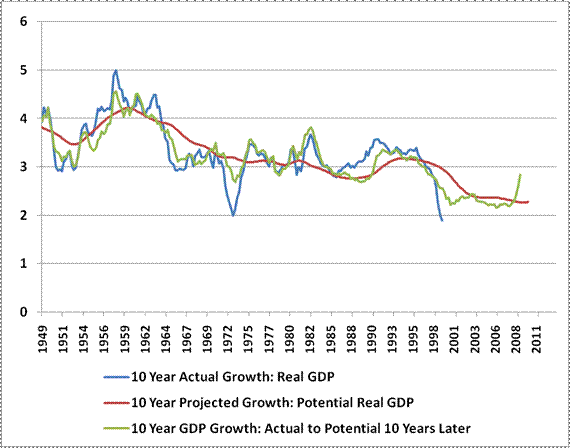
Meaning you have no idea about the idea of the momentum and timing of an economy.ONE of Carter's last three years was MARGINALLY negative, and you characterize that in terms just short of apocalyptic.
You seem to be a bit of a hack, clemtard.
You're in so far over your head, you can't even see daylight.
16 Feb 2014 1:43 pm
You really shouldn't be talking about people bungling numbers when YOUR bungled numbers conflict with the graph you used to support them.Cannonpointer » 16 Feb 2014 1:41 pm » wrote: No, his 8th grade grammar teacher. His math is right, the way HE set it up - just not the way I set it up. He misread the words. He doesn't understand prepositions. Word problems start with words and work on to math. He bungled the words, then got the math right (from a bungled beginning).
16 Feb 2014 1:45 pm
What, then, was Reagan's? I already addressed inflation using the debt to GDP ratio. You can take the math from either side - straight dollars, or ratios to account for inflation, - and Reagan still doesn't look as good as Carter.tharock220 » 16 Feb 2014 12:16 pm » wrote:
I was going to get to that, but the lolberals' inability to do basic percentage change calculations diverted me. GDP doesn't distinguish between real growth and inflation. An example, under liberal economics if one widget is $1 in 2013 and it's $2 in 2014 then that's growth. Conversely, if a widget is $1 in 2013, but two are produced in 2014 for $.50 each, then you have had no growth. Basically, all of Jimmy Carter's growth was inflation.
Carter added 288 billions to the national debt - which actually REDUCED the debt as a portion of the GDP (due to how much it grew by under his hand, with a democrat congress).
Reagan added 1.873 TRILLIONS to the national debt, which GREW our national debt, as a function of GDP, for the first time since WW!! - TRIPLED THE NATIONAL DEBT as measured in dollars (does not account for inflation), and grew it by a whopping 23.5% as a function of GDP (ACCOUNTS FOR INFLATION)!
Those are the two ways of measuring that I propose. If you propose a third or dispute my treatment of either of those two, show your math. So far, you've demonstrated that our disagreements will be at the feet of your 8th grade grammar teacher.
When you complain, ur friends roll their eyes and ur enemies rejoice
"Because I SAY I am" is a todler's tantrum, not "science"
You cannot betray me - only yourself, to me.
Who cuts off your dick is not a friend
An opinion you won't defend is not your own
Humanity's Law of the Jungle: Survival NOT of the fittest, but of the tribe
When peeing in the pool, stand on the edge
If gender is not sex, why should a gender claim change what sex you shower with?
"Because I SAY I am" is a todler's tantrum, not "science"
You cannot betray me - only yourself, to me.
Who cuts off your dick is not a friend
An opinion you won't defend is not your own
Humanity's Law of the Jungle: Survival NOT of the fittest, but of the tribe
When peeing in the pool, stand on the edge
If gender is not sex, why should a gender claim change what sex you shower with?
16 Feb 2014 1:48 pm
You are dishonestly using Carter's third - and only negative - fiscal year in this statement.golfboy » 16 Feb 2014 12:21 pm » wrote:Carter took an economy growing at over 5%, and handed it off at -0.2%
Reagan took that -0.2% and left it at 4.2%.
And idiots like Cannon claim Carter was a success.
When you complain, ur friends roll their eyes and ur enemies rejoice
"Because I SAY I am" is a todler's tantrum, not "science"
You cannot betray me - only yourself, to me.
Who cuts off your dick is not a friend
An opinion you won't defend is not your own
Humanity's Law of the Jungle: Survival NOT of the fittest, but of the tribe
When peeing in the pool, stand on the edge
If gender is not sex, why should a gender claim change what sex you shower with?
"Because I SAY I am" is a todler's tantrum, not "science"
You cannot betray me - only yourself, to me.
Who cuts off your dick is not a friend
An opinion you won't defend is not your own
Humanity's Law of the Jungle: Survival NOT of the fittest, but of the tribe
When peeing in the pool, stand on the edge
If gender is not sex, why should a gender claim change what sex you shower with?
16 Feb 2014 1:49 pm
This psychotic can't even tell if the sun is shining, let alone analyze statistics and their meaning in the large sense.Cannonpointer » 16 Feb 2014 1:37 pm » wrote:Make up your mind. In your math, you show -0.2 as the third number, using the October fiscal year as the measuring stick. But in your follow-on explanation, you use -0.2 as the hand-off year, using the election year as the measuring stick. This type of mathematical mishmash is poor presentation, son.
I will get to your presentation soon, so please: Try to refine it in the interim, make it less dishonest.

Whose analysis should we accept, that of a psychotic moonbat? Or thecountry's best publications on the subject?
Reagan's Legacy: Our 25-Year Boom
By Investor's Business Daily....
Let's go back to 1982, in many ways the bleakest year since the Depression. The economy had emerged severely damaged by the stagflation of the 1970s. Americans' confidence, both in government and in the economy, had reached a low ebb in 1980. Many felt our best years lay behind us.
On the nations' campuses and even in some of its boardrooms, people were talking about capitalism as a failed system. ....
It was Reagan who brought America's capitalist economy roaring back to life, ending energy price controls, slashing income tax rates by 25% and dramatically reducing tax rates on capital gains.
Americans had been told for years — as they're now being told again — to expect diminished standards of living. Then they watched as the Reagan years set in place one of the most durable and remarkable booms in incomes and wealth in history.
Yet the media and academia rarely credited Reagan for his accomplishments — especially on the economy, where "Reaganomics" became a term of opprobrium among the intelligentsia.
But it's a fact. As the nonpartisan National Bureau of Economic Research once declared, we lived in the "longest sustained period of prosperity in the 20th century" from 1982 to 1999 — one big boom, the NBER said, set off by Reagan.
Reagan's magic was simple. He wanted to lower interest rates, slash inflation, cut unemployment and boost economic growth. These things, at the time, seemed impossible. But he did it.
The so-called misery index — that is, unemployment plus inflation — hit 21% as Reagan was elected in 1980. By the time his terms were over, it had plunged to around 9%.
Interest rates likewise plunged — contrary to the predictions of many pundits, who boldly predicted that the budget deficits which emerged in the 1980s would send rates spiraling upward. From a stratospheric 21% in 1980, the prime rate fell to 7% by decade's end.
During the 1970s, many Americans for the first time saw incomes shrink. But from 1981 to 1989, median real household income rose by $4,000. The poorest Americans, who saw their incomes fall 5% in the 1970s, watched their incomes rise 6% in the 1980s.
http://www.realclearmarkets.com/article ... _boom.html
16 Feb 2014 1:49 pm
Another desperate restatement of the conservative media's meme. Crimson is really "bringing it" today.crimsongulf » 16 Feb 2014 12:22 pm » wrote:
Simply look at the results of each administration, then talk agenda. Carter damned near took us under with incompetency, not too mention damaging the American spirit more than any POTUS to date at that time. He has now been surpassed by barry for that title.
When you complain, ur friends roll their eyes and ur enemies rejoice
"Because I SAY I am" is a todler's tantrum, not "science"
You cannot betray me - only yourself, to me.
Who cuts off your dick is not a friend
An opinion you won't defend is not your own
Humanity's Law of the Jungle: Survival NOT of the fittest, but of the tribe
When peeing in the pool, stand on the edge
If gender is not sex, why should a gender claim change what sex you shower with?
"Because I SAY I am" is a todler's tantrum, not "science"
You cannot betray me - only yourself, to me.
Who cuts off your dick is not a friend
An opinion you won't defend is not your own
Humanity's Law of the Jungle: Survival NOT of the fittest, but of the tribe
When peeing in the pool, stand on the edge
If gender is not sex, why should a gender claim change what sex you shower with?
16 Feb 2014 1:49 pm
Your chart confirmed I used the right numbers, and you are lying now.Cannonpointer » 16 Feb 2014 1:48 pm » wrote: You are dishonestly using Carter's third - and only negative - fiscal year in this statement.

1977 through 1980 (4.6 + 5.6 + 3.2 + -0.2) / 4 = 3.4
16 Feb 2014 1:51 pm
You poor little thing. GDP stats ARE results!crimsongulf » 16 Feb 2014 12:28 pm » wrote:Again, I go to results, GDP statistics under either one have no meaning. Results do, so Reagan wins easily on that.

Tell us, what "results" are YOU talking about?
When you complain, ur friends roll their eyes and ur enemies rejoice
"Because I SAY I am" is a todler's tantrum, not "science"
You cannot betray me - only yourself, to me.
Who cuts off your dick is not a friend
An opinion you won't defend is not your own
Humanity's Law of the Jungle: Survival NOT of the fittest, but of the tribe
When peeing in the pool, stand on the edge
If gender is not sex, why should a gender claim change what sex you shower with?
"Because I SAY I am" is a todler's tantrum, not "science"
You cannot betray me - only yourself, to me.
Who cuts off your dick is not a friend
An opinion you won't defend is not your own
Humanity's Law of the Jungle: Survival NOT of the fittest, but of the tribe
When peeing in the pool, stand on the edge
If gender is not sex, why should a gender claim change what sex you shower with?
16 Feb 2014 1:53 pm
Your last mouth-fart had the number at 2.8. Two sets of numbers, one mouth.golfboy » 16 Feb 2014 1:49 pm » wrote: Your chart confirmed I used the right numbers, and you are lying now.
1977 through 1980 (4.6 + 5.6 + 3.2 + -0.2) / 4 = 3.4
IS THIS THE NUMBER YOU ARE STICKING WITH? YES/NO?
When you complain, ur friends roll their eyes and ur enemies rejoice
"Because I SAY I am" is a todler's tantrum, not "science"
You cannot betray me - only yourself, to me.
Who cuts off your dick is not a friend
An opinion you won't defend is not your own
Humanity's Law of the Jungle: Survival NOT of the fittest, but of the tribe
When peeing in the pool, stand on the edge
If gender is not sex, why should a gender claim change what sex you shower with?
"Because I SAY I am" is a todler's tantrum, not "science"
You cannot betray me - only yourself, to me.
Who cuts off your dick is not a friend
An opinion you won't defend is not your own
Humanity's Law of the Jungle: Survival NOT of the fittest, but of the tribe
When peeing in the pool, stand on the edge
If gender is not sex, why should a gender claim change what sex you shower with?

16 Feb 2014 1:54 pm

I'm saying exactly what I said. Reagan was innovative in ways that Carter wasn't. Reagan came into office with an economic theory burning a hole in his pocket. He loosed it on the economy right out of the gate. He was forced to reconsider his theoretical economic policies a few years later and managed to scramble together a plan to get himself out of the hole he created without losing face. Carter had his own economic policies of course, though they were far less impactful and far reaching. Both failed, though Carter's failed within his Presidency. Reagan's were a slow, accumulating failure so far removed from the origin, some tend to forget that he was the creator.crimsongulf » 16 Feb 2014 12:59 pm » wrote: So, are you saying that we would have been better off with Carter? If so, how do you think he would have changed history.
Carter fades into oblivion, the poor sap who left behind gas lines, a recession and hostages in Iran. Reagan left office with credit for rescuing the hostages (a double edged sword considering the arms for hostages fiasco) ending the cold war (deserved or not) an economy that was holding its own and a string of economic policies that he managed to weave into the fabric of American consciousness and policy for years to come.
Who changed history? Reagan did. So much so, we still remember him as we attempt to crawl out from under the tax policies he instituted. Carter is barely a blip on the radar. Give me a hundred Carters who do no lasting harm than a single Reagan who **** up the whole enchilada for decades.
16 Feb 2014 1:56 pm
Yet anecdotes and rhetoric are so easy to spew and so meaningless against hard numbers. Isn't life funny?crimsongulf » 16 Feb 2014 12:41 pm » wrote:
Given enough google time, one can contradict any number or graph posted on this forum, but it never changes the bottom line.
When you complain, ur friends roll their eyes and ur enemies rejoice
"Because I SAY I am" is a todler's tantrum, not "science"
You cannot betray me - only yourself, to me.
Who cuts off your dick is not a friend
An opinion you won't defend is not your own
Humanity's Law of the Jungle: Survival NOT of the fittest, but of the tribe
When peeing in the pool, stand on the edge
If gender is not sex, why should a gender claim change what sex you shower with?
"Because I SAY I am" is a todler's tantrum, not "science"
You cannot betray me - only yourself, to me.
Who cuts off your dick is not a friend
An opinion you won't defend is not your own
Humanity's Law of the Jungle: Survival NOT of the fittest, but of the tribe
When peeing in the pool, stand on the edge
If gender is not sex, why should a gender claim change what sex you shower with?
16 Feb 2014 1:56 pm
WTF are you claiming now? I used two sets of numbers to show your claim that I was using the wrong numbers was wrong.Cannonpointer » 16 Feb 2014 1:53 pm » wrote:
Your last mouth-fart had the number at 2.8. Two sets of numbers, one mouth.
IS THIS THE NUMBER YOU ARE STICKING WITH? YES/NO?
Your chart showed Carter's average GDP at 3.4%
Only ONE set of numbers comes out to an average of 3.4%: 1977 through 1980 (4.6 + 5.6 + 3.2 + -0.2) / 4 = 3.4
If your claim was correct and the other set of numbers were correct, than Carter's average GCP would only be 2.8%.
So, which is correct, your claim that Carter's average GDP was 2.8%, or the graph YOU used to support your position that showed it at 3.4%?
16 Feb 2014 1:57 pm
LOL. I love watching someone who abandoned her country claim that "we" are doing anything.greatnpowerfuloz » 16 Feb 2014 1:54 pm » wrote:Who changed history? Reagan did. We are still attempting to crawl out from under the tax policies he instituted. Carter is barely a blip on the radar. Give me a hundred Carters who do no lasting harm than a single Reagan who **** up the whole enchilada for decades.
You are contributing NOTHING to our country, so please don't include yourself in our issues.
16 Feb 2014 1:59 pm
"Meme?"Cannonpointer » 16 Feb 2014 1:49 pm » wrote:Another desperate restatement of the conservative media's meme. Crimson is really "bringing it" today.
It's called reality, psycho.
The Real Reagan Economic Record: Responsible and Successful Fiscal Policy
By Peter B. Sperry....
President Ronald Reagan's record includes sweeping economic reforms and deep across-the-board tax cuts, market deregulation, and sound monetary policies to contain inflation. His policies resulted in the largest peacetime economic boom in American history and nearly 35 million more jobs. As the Joint Economic Committee reported in April 2000:2
In 1981, newly elected President Ronald Reagan refocused fiscal policy on the long run. He proposed, and Congress passed, sharp cuts in marginal tax rates. The cuts increased incentives to work and stimulated growth. These were funda-mental policy changes that provided the foundation for the Great Expansion that began in December 1982.
As Exhibit 1 shows, the economic record of the last 17 years is remarkable, particularly when viewed against the backdrop of the 1970s. The United States has experienced two of the longest and strongest expansions in our history back to back. They have been interrupted only by a shallow eight-month downturn in 1990-91....
HOW DID THE REAGAN TAX CUTS AFFECT THE U.S. TREASURY?
Many critics of reducing taxes claim that the Reagan tax cuts drained the U.S. Treasury. The reality is that federal revenues increased significantly between 1980 and 1990:
Total federal revenues doubled from just over $517 billion in 1980 to more than $1 trillion in 1990. In constant inflation-adjusted dollars, this was a 28 percent increase in revenue.3
As a percentage of the gross domestic product (GDP), federal revenues declined only slightly from 18.9 percent in 1980 to 18 percent in 1990.4....
Despite the steep recession in 1982--brought on by tight money policies that were instituted to squeeze out the historic inflation level of the late 1970s--by 1983, the Reagan policies of reducing taxes, spending, regulation, and inflation were in place. The result was unprecedented economic growth:
This economic boom lasted 92 months without a recession, from November 1982 to July 1990, the longest period of sustained growth during peacetime and the second-longest period of sustained growth in U.S. history. The growth in the economy lasted more than twice as long as the average period of expansions since World War II.10
The American economy grew by about one-third in real inflation-adjusted terms. This was the equivalent of adding the entire economy of East and West Germany or two-thirds of Japan's economy to the U.S. economy.11
From 1950 to 1973, real economic growth in the U.S. economy averaged 3.6 percent per year. From 1973 to 1982, it averaged only 1.6 percent. The Reagan economic boom restored the more usual growth rate as the economy averaged 3.5 percent in real growth from the beginning of 1983 to the end of 1990.12....
CONCLUSION
No matter how advocates of big government try to rewrite history, Ronald Reagan's record of fiscal responsibility continues to stand as the most successful economic policy of the 20th century. His tax reforms triggered an economic expansion that continues to this day.
http://www.heritage.org/research/report ... mic-record
16 Feb 2014 2:00 pm
greatnpowerfuloz » 16 Feb 2014 1:54 pm » wrote:Both failed, though Carter's failed within his Presidency. Reagan's were a slow, accumulating failure so far removed from the origin, we tend to forget that he was the creator.
Stick to macrame or yoga or jogging, moonbat.
16 Feb 2014 2:01 pm
That depends on whether you're going to understand that you have yourself backed into a Keynesian corner, contard (needed the alliteration - sorry).crimsongulf » 16 Feb 2014 12:59 pm » wrote:
So, are you saying that we would have been better off with Carter? If so, how do you think he would have changed history.
If you factor in that Reagan almost doubled the economy using 2 TRILLION DOLLARS OF DEBT, then "you" and "we" are better off for it, so long as "you" and "we" does not include the precious, precious unborn.
You guys want to have it both ways and then the third way. WHEN YOU PULL REAGAN'S TWO TRILLION BORROWED DOLLARS OUT OF THE ECONOMY, he added less than 400 billion in 8 years - LESS THAN INFLATION.
When you complain, ur friends roll their eyes and ur enemies rejoice
"Because I SAY I am" is a todler's tantrum, not "science"
You cannot betray me - only yourself, to me.
Who cuts off your dick is not a friend
An opinion you won't defend is not your own
Humanity's Law of the Jungle: Survival NOT of the fittest, but of the tribe
When peeing in the pool, stand on the edge
If gender is not sex, why should a gender claim change what sex you shower with?
"Because I SAY I am" is a todler's tantrum, not "science"
You cannot betray me - only yourself, to me.
Who cuts off your dick is not a friend
An opinion you won't defend is not your own
Humanity's Law of the Jungle: Survival NOT of the fittest, but of the tribe
When peeing in the pool, stand on the edge
If gender is not sex, why should a gender claim change what sex you shower with?
16 Feb 2014 2:05 pm
WHAT SOURCES, moonbat? You have not brought ONE SOURCE to this thread. Nor have you made even a feeble attempt to refute mine. You've groused. That's it. You've just mumbled and groused.RichClem » 16 Feb 2014 1:28 pm » wrote:
Prove my sources are partisan, moonbat.
Okay, okay, this again. I USED to bring it, and it's your fault you were not there in my glory days, back when I did more than spew rhetoric.RichClem » 16 Feb 2014 1:28 pm » wrote: I have had many threads on the subject filled with data and logic.
Gotcha, Glory Hole.

When you complain, ur friends roll their eyes and ur enemies rejoice
"Because I SAY I am" is a todler's tantrum, not "science"
You cannot betray me - only yourself, to me.
Who cuts off your dick is not a friend
An opinion you won't defend is not your own
Humanity's Law of the Jungle: Survival NOT of the fittest, but of the tribe
When peeing in the pool, stand on the edge
If gender is not sex, why should a gender claim change what sex you shower with?
"Because I SAY I am" is a todler's tantrum, not "science"
You cannot betray me - only yourself, to me.
Who cuts off your dick is not a friend
An opinion you won't defend is not your own
Humanity's Law of the Jungle: Survival NOT of the fittest, but of the tribe
When peeing in the pool, stand on the edge
If gender is not sex, why should a gender claim change what sex you shower with?
Who is online
In total there are 7411 users online :: 0 registered, 12 bots, and 7399 guests
Registered users:
Bots: MicroMessenger, curl/7, ADmantX, TTD-Content, CriteoBot, proximic, LCC, Googlebot, bingbot, facebookexternalhit, Mediapartners-Google, Applebot