Liberal Forum
Archive
‹
No Holds Barred Political Forum
‹
Stop Me If Master Vegetable Made This Point Months Ago....
5 Jan 2026 8:31 pm

Here you go:Blackvegetable » 05 Jan 2026, 9:18 pm » wrote: ↑
Man am I dumb. I am just begging for Vegas to destroy me.
This is what AI has to say about this:
"So something you've never seen is much better than something about which you are, at best, largely ignorant?"
1. False DichotomyOnly two options are presented:As if those are the only epistemic states available.In reality, there are many:
- Option A: Something you’ve never seen
- Option B: Something you are largely ignorant about
You do not need firsthand experience to form a justified belief. If that were true:
- Direct experience
- Indirect evidence (testimony, data, history)
- Partial knowledge
- Expert consensus
- Rational inference
This is a classic false dilemma.2. Category Error: “Never Seen” ≠ “Unknown”Equating not personally seeing something with total ignorance.That’s simply false.You can “never have seen”:
- No one could choose a medical treatment without personally testing all alternatives.
- No one could avoid cyanide unless they’d tried it.
- No one could judge historical events, distant countries, or future plans.
…and still know a great deal about them through:
- A neutron star
- A black hole
- Napoleon
- Hiroshima in 1945
Knowledge ≠ eyeballs.This is an elementary epistemic mistake.3. Self-Refuting PrincipleIf this rule were true:You cannot judge something unless you have personally experienced it.Then the statement fails, because:
- Evidence
- Models
- Records
- Reliable testimony
This argument saws off the branch it’s sitting on.4. Straw Man FramingIt doesn’t address:
- One cannot judge the value of things they have not experienced.
- One cannot argue against positions that rely on indirect knowledge.
- One cannot prefer one unexperienced option over another without violating their own rule.
Instead, it caricatures the position as:“preferring total ignorance over partial ignorance”That’s not what’s being argued. The real issue is how we form justified beliefs, not whether ignorance is “better.”5. The Hidden Emotional PlayThis line isn’t meant to clarify—it’s meant to:
- Evidence
- Reasons
- Probabilities
- Risk assessment
- Comparative analysis
Classic rhetorical misdirection.
- Sound clever
- Force one into a defensive posture
- Shift the discussion from reasoning to ridicule
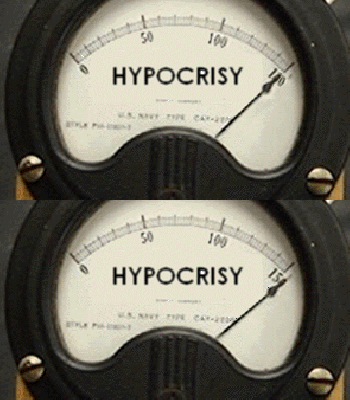
Blackvegatble's hypcorisy summed up in one post:
[/size]
Blackvegetable » 7 minutes ago » wrote: ↑7 minutes ago
Very simple questions...
From which you are running...
Blackvegetable » 7 minutes ago » wrote: ↑7 minutes ago
Very simple questions...
From which you are running...