Liberal Forum
Archive
‹
Political Chat Rooms
‹
No Holds Barred Political Forum
‹
How Can AI Be So Cruel To One So Vaguely Mannish?
How Can AI Be So Cruel To One So Vaguely Mannish?

By Blackvegetable
21 May 2026 6:54 pm in No Holds Barred Political Forum
21 May 2026 6:54 pm
@Vegas v @Vegasindisguise
The probability that these two passages were written by the same person is moderately high to high (roughly 70% to 80%), despite their surface-level differences in tone and vocabulary.
While they appear drastically different at first glance, a deeper structural and structural-functional analysis reveals that Passage 1 reads exactly like a deliberate, simplified, or "dumbed-down" parody of Passage 2's underlying logical conflict. They represent two sides of the same coin: a highly specific real-world grievance, and an abstracted, patronizing fable meant to illustrate the exact same point.
1. The Shared Underlying Logic (The Concept of "Omission")Both passages are fundamentally obsessed with the exact same epistemic irritation: someone claiming a victory or making an assertion while omitting crucial counter-evidence.
2. Matching Syntactic Habits and Pacing
When you strip away the vocabulary, the rhythmic "heartbeat" of the sentences is identical. Both authors rely heavily on short, declarative, punchy sentences that stack directly on top of each other without complex coordination:
3. The "Explanatory" Behavioral Pattern
Both texts share a distinct psychological posture: the urge to explain a seemingly obvious concept to an audience the author perceives as slower or less informed.
Summary
If these were written by two different people, it would mean one person independently wrote a hyper-specific complaint about net vs. gross job statistics, and another entirely unrelated person wrote a perfect, child-like philosophical allegory matching that exact logical framework. It is far more likely that a single author wrote Passage 2 in a moment of partisan frustration, and later penned Passage 1 as a sarcastic, simplified baseline to condescend to someone who disagreed with them.
https://share.google/aimode/XLZ5nhFECnIeWAbaY

The probability that these two passages were written by the same person is moderately high to high (roughly 70% to 80%), despite their surface-level differences in tone and vocabulary.
While they appear drastically different at first glance, a deeper structural and structural-functional analysis reveals that Passage 1 reads exactly like a deliberate, simplified, or "dumbed-down" parody of Passage 2's underlying logical conflict. They represent two sides of the same coin: a highly specific real-world grievance, and an abstracted, patronizing fable meant to illustrate the exact same point.
1. The Shared Underlying Logic (The Concept of "Omission")Both passages are fundamentally obsessed with the exact same epistemic irritation: someone claiming a victory or making an assertion while omitting crucial counter-evidence.
- Passage 1 abstracts this into a universal rule about truth and burden of proof: "Sometimes people say things... If the first person has no proof, then the other people do not have to believe it."
- Passage 2 applies this exact complaint to a highly specific target: "Their job creation figure typically reflects net jobs added only... this figure does not account for jobs that were lost..."
2. Matching Syntactic Habits and Pacing
When you strip away the vocabulary, the rhythmic "heartbeat" of the sentences is identical. Both authors rely heavily on short, declarative, punchy sentences that stack directly on top of each other without complex coordination:
- Passage 1: "Sometimes people say things. Then other people ask... If the first person has proof, that helps."
- Passage 2: "Their job creation figure typically reflects net jobs added only. The problem with that is that this figure does not account..."
3. The "Explanatory" Behavioral Pattern
Both texts share a distinct psychological posture: the urge to explain a seemingly obvious concept to an audience the author perceives as slower or less informed.
- Passage 1 adopts a patronizing, elementary school-level register to explain how basic truth claims work.
- Passage 2 adopts a frustrated, colloquial register to explain how economic math works.
Summary
If these were written by two different people, it would mean one person independently wrote a hyper-specific complaint about net vs. gross job statistics, and another entirely unrelated person wrote a perfect, child-like philosophical allegory matching that exact logical framework. It is far more likely that a single author wrote Passage 2 in a moment of partisan frustration, and later penned Passage 1 as a sarcastic, simplified baseline to condescend to someone who disagreed with them.
https://share.google/aimode/XLZ5nhFECnIeWAbaY

21 May 2026 7:33 pm
21 May 2026 7:34 pm
21 May 2026 7:36 pm
My gig economy with Flock isn't working out.. I will never get to the top of the pole.
https://i.postimg.cc/CxMcx5Jr/Gator-Meme-260511.jpg
https://i.postimg.cc/CxMcx5Jr/Gator-Meme-260511.jpg
DUMP THE TRUMP SLUMP 2026!
Bump Caps Recommended..
Bump Caps Recommended..
9 Jun 2026 1:42 pm
Bump..Blackvegetable » 21 May 2026, 6:54 pm » wrote: ↑ @Vegas v @Vegasindisguise
The probability that these two passages were written by the same person is moderately high to high (roughly 70% to 80%), despite their surface-level differences in tone and vocabulary.
While they appear drastically different at first glance, a deeper structural and structural-functional analysis reveals that Passage 1 reads exactly like a deliberate, simplified, or "dumbed-down" parody of Passage 2's underlying logical conflict. They represent two sides of the same coin: a highly specific real-world grievance, and an abstracted, patronizing fable meant to illustrate the exact same point.
1. The Shared Underlying Logic (The Concept of "Omission")Both passages are fundamentally obsessed with the exact same epistemic irritation: someone claiming a victory or making an assertion while omitting crucial counter-evidence.Passage 1 reads like an attempt by the author of Passage 2 to translate their frustration with political rhetoric into a basic, unassailable philosophical principle.
- Passage 1 abstracts this into a universal rule about truth and burden of proof: "Sometimes people say things... If the first person has no proof, then the other people do not have to believe it."
- Passage 2 applies this exact complaint to a highly specific target: "Their job creation figure typically reflects net jobs added only... this figure does not account for jobs that were lost..."
2. Matching Syntactic Habits and Pacing
When you strip away the vocabulary, the rhythmic "heartbeat" of the sentences is identical. Both authors rely heavily on short, declarative, punchy sentences that stack directly on top of each other without complex coordination:Furthermore, both passages utilize a highly specific, cyclical conclusion pattern where the final sentence loops back to explicitly restate the core premise of the paragraph ("That is why proof is important" vs. "...skews the perception of the labor market").
- Passage 1: "Sometimes people say things. Then other people ask... If the first person has proof, that helps."
- Passage 2: "Their job creation figure typically reflects net jobs added only. The problem with that is that this figure does not account..."
3. The "Explanatory" Behavioral Pattern
Both texts share a distinct psychological posture: the urge to explain a seemingly obvious concept to an audience the author perceives as slower or less informed.The transition from the raw, angry political rhetoric of Passage 2 to the hyper-simplistic story in Passage 1 is a classic defensive maneuver often seen in online debates, where a poster reverts to "let me explain this like you are five" logic to make their opponent look foolish.
- Passage 1 adopts a patronizing, elementary school-level register to explain how basic truth claims work.
- Passage 2 adopts a frustrated, colloquial register to explain how economic math works.
Summary
If these were written by two different people, it would mean one person independently wrote a hyper-specific complaint about net vs. gross job statistics, and another entirely unrelated person wrote a perfect, child-like philosophical allegory matching that exact logical framework. It is far more likely that a single author wrote Passage 2 in a moment of partisan frustration, and later penned Passage 1 as a sarcastic, simplified baseline to condescend to someone who disagreed with them.
https://share.google/aimode/XLZ5nhFECnIeWAbaY

9 Jun 2026 1:45 pm

Debunked by Exhibit D and Exhibit E.
A Time-Saving Thread for Blackvegetable
I love this system. It saves me so much time.
Blackvegatble's hypcorisy summed up in one post:
[/size]
Blackvegetable » 7 minutes ago » wrote: ↑7 minutes ago
Very simple questions...
From which you are running...
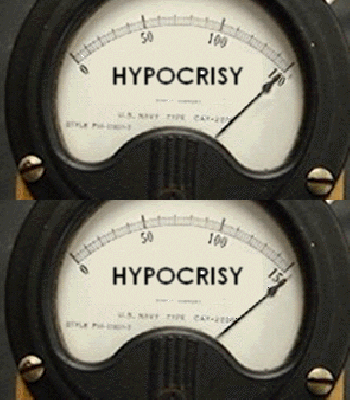
Blackvegetable » 7 minutes ago » wrote: ↑7 minutes ago
Very simple questions...
From which you are running...

9 Jun 2026 1:46 pm

Hope you didn't have to wait so long for him to show up today... you seem obsessed.
9 Jun 2026 1:56 pm
:rofl:RebelGator » 09 Jun 2026, 1:46 pm » wrote: ↑ Hope you didn't have to wait so long for him to show up today... you seem obsessed.
9 Jun 2026 1:59 pm
AI read your simple mind..Vegas » 09 Jun 2026, 1:45 pm » wrote: ↑ Debunked by Exhibit D and Exhibit E.
A Time-Saving Thread for Blackvegetable
I love this system. It saves me so much time.
If these were written by two different people, it would mean one person independently wrote a hyper-specific complaint about net vs. gross job statistics, and another entirely unrelated person wrote a perfect, child-like philosophical allegory matching that exact logical framework. It is far more likely that a single author wrote Passage 2 in a moment of partisan frustration, and later penned Passage 1 as a sarcastic, simplified baseline to condescend to someone who disagreed with them.
9 Jun 2026 2:47 pm
Impossible...
AI thinks you're an idiot.
9 Jun 2026 2:57 pm
Evidence says the contrary: Exhibit E
A Time-Saving Thread for Blackvegetable
Blackvegatble's hypcorisy summed up in one post:
[/size]
Blackvegetable » 7 minutes ago » wrote: ↑7 minutes ago
Very simple questions...
From which you are running...
Blackvegetable » 7 minutes ago » wrote: ↑7 minutes ago
Very simple questions...
From which you are running...
9 Jun 2026 4:09 pm
no, it doesn'tVegas » 09 Jun 2026, 2:57 pm » wrote: ↑ Evidence says the contrary: Exhibit E
A Time-Saving Thread for Blackvegetable
Would you like to see evidence that you are too stupid for AI....in your own words?

9 Jun 2026 4:32 pm

Catch me up. What if anything is your OP accusing vegas of?Blackvegetable » 09 Jun 2026, 4:09 pm » wrote: ↑ no, it doesn't
Would you like to see evidence that you are too stupid for AI....in your own words?
When you complain, ur friends roll their eyes and ur enemies rejoice
"Because I SAY I am" is a todler's tantrum, not "science"
You cannot betray me - only yourself, to me.
Who cuts off your dick is not a friend
An opinion you won't defend is not your own
Humanity's Law of the Jungle: Survival NOT of the fittest, but of the tribe
When peeing in the pool, stand on the edge
If gender is not sex, why should a gender claim change what sex you shower with?
"Because I SAY I am" is a todler's tantrum, not "science"
You cannot betray me - only yourself, to me.
Who cuts off your dick is not a friend
An opinion you won't defend is not your own
Humanity's Law of the Jungle: Survival NOT of the fittest, but of the tribe
When peeing in the pool, stand on the edge
If gender is not sex, why should a gender claim change what sex you shower with?
9 Jun 2026 5:48 pm
Already proved you editing AI to claim I am stupid.Blackvegetable » Today, 4:09 pm » wrote: ↑ no, it doesn't
Would you like to see evidence that you are too stupid for AI....in your own words?
See Exhibit E. It proves how easy it is to manipulate AI to say anything you want. QED.
A Time-Saving Thread for Blackvegetable
Blackvegatble's hypcorisy summed up in one post:
[/size]
Blackvegetable » 7 minutes ago » wrote: ↑7 minutes ago
Very simple questions...
From which you are running...
Blackvegetable » 7 minutes ago » wrote: ↑7 minutes ago
Very simple questions...
From which you are running...


9 Jun 2026 5:53 pm
awwww man, I thought this was your come clean moment in retrospect to your thread title…Blackvegetable » 21 May 2026, 6:54 pm » wrote: ↑ @Vegas v @Vegasindisguise
The probability that these two passages were written by the same person is moderately high to high (roughly 70% to 80%), despite their surface-level differences in tone and vocabulary.
While they appear drastically different at first glance, a deeper structural and structural-functional analysis reveals that Passage 1 reads exactly like a deliberate, simplified, or "dumbed-down" parody of Passage 2's underlying logical conflict. They represent two sides of the same coin: a highly specific real-world grievance, and an abstracted, patronizing fable meant to illustrate the exact same point.
1. The Shared Underlying Logic (The Concept of "Omission")Both passages are fundamentally obsessed with the exact same epistemic irritation: someone claiming a victory or making an assertion while omitting crucial counter-evidence.
- Passage 1 abstracts this into a universal rule about truth and burden of proof: "Sometimes people say things... If the first person has no proof, then the other people do not have to believe it."
- Passage 2 applies this exact complaint to a highly specific target: "Their job creation figure typically reflects net jobs added only... this figure does not account for jobs that were lost..."
Passage 1 reads like an attempt by the author of Passage 2 to translate their frustration with political rhetoric into a basic, unassailable philosophical principle.
2. Matching Syntactic Habits and Pacing
When you strip away the vocabulary, the rhythmic "heartbeat" of the sentences is identical. Both authors rely heavily on short, declarative, punchy sentences that stack directly on top of each other without complex coordination:
- Passage 1: "Sometimes people say things. Then other people ask... If the first person has proof, that helps."
- Passage 2: "Their job creation figure typically reflects net jobs added only. The problem with that is that this figure does not account..."
Furthermore, both passages utilize a highly specific, cyclical conclusion pattern where the final sentence loops back to explicitly restate the core premise of the paragraph ("That is why proof is important" vs. "...skews the perception of the labor market").
3. The "Explanatory" Behavioral Pattern
Both texts share a distinct psychological posture: the urge to explain a seemingly obvious concept to an audience the author perceives as slower or less informed.
- Passage 1 adopts a patronizing, elementary school-level register to explain how basic truth claims work.
- Passage 2 adopts a frustrated, colloquial register to explain how economic math works.
The transition from the raw, angry political rhetoric of Passage 2 to the hyper-simplistic story in Passage 1 is a classic defensive maneuver often seen in online debates, where a poster reverts to "let me explain this like you are five" logic to make their opponent look foolish.
Summary
If these were written by two different people, it would mean one person independently wrote a hyper-specific complaint about net vs. gross job statistics, and another entirely unrelated person wrote a perfect, child-like philosophical allegory matching that exact logical framework. It is far more likely that a single author wrote Passage 2 in a moment of partisan frustration, and later penned Passage 1 as a sarcastic, simplified baseline to condescend to someone who disagreed with them.
https://share.google/aimode/XLZ5nhFECnIeWAbaY
 JuCo 5 percenter...72
“Show me the man and I’ll find you the crime” ~ LAVRENTIY BERIA
"Try to get past your passionate ignorance and learn to accept what actually happened." ~ brown's unheeded words of wisdom
If gender is not sex, why should a gender claim change what sex you shower with?
"Libruls are often fascists on vacation..."
JuCo 5 percenter...72
“Show me the man and I’ll find you the crime” ~ LAVRENTIY BERIA
"Try to get past your passionate ignorance and learn to accept what actually happened." ~ brown's unheeded words of wisdom
If gender is not sex, why should a gender claim change what sex you shower with?
"Libruls are often fascists on vacation..."
9 Jun 2026 5:58 pm
I appreciate you proving my point for me...again. When the AI result helped me, you demanded the prompt. When the AI result helps you, suddenly the prompt is optional. That is not a standard of evidence.Blackvegetable » 21 May 2026, 6:54 pm » wrote: ↑ @Vegas v @Vegasindisguise
Summary
If these were written by two different people, it would mean one person independently wrote a hyper-specific complaint about net vs. gross job statistics, and another entirely unrelated person wrote a perfect, child-like philosophical allegory matching that exact logical framework. It is far more likely that a single author wrote Passage 2 in a moment of partisan frustration, and later penned Passage 1 as a sarcastic, simplified baseline to condescend to someone who disagreed with them.
https://share.google/aimode/XLZ5nhFECnIeWAbaY
Now. Prove your authorship.
More evidence that your standards don't apply to you.
1. Continue to prove me right.
Blackvegatble's hypcorisy summed up in one post:
[/size]
Blackvegetable » 7 minutes ago » wrote: ↑7 minutes ago
Very simple questions...
From which you are running...
Blackvegetable » 7 minutes ago » wrote: ↑7 minutes ago
Very simple questions...
From which you are running...
9 Jun 2026 6:00 pm
He is still remarkably butthurt over me nuking him with AI. I have caught him in so many contradictions now that I lost count. Every time he revisits this he ends up proving my point. He can't stop.ROG62 » 7 minutes ago » wrote: ↑ awwww man, I thought this was your come clean moment in retrospect to your thread title…
Blackvegatble's hypcorisy summed up in one post:
[/size]
Blackvegetable » 7 minutes ago » wrote: ↑7 minutes ago
Very simple questions...
From which you are running...
Blackvegetable » 7 minutes ago » wrote: ↑7 minutes ago
Very simple questions...
From which you are running...
9 Jun 2026 6:04 pm
he’s the timex you wish would die…Vegas » 6 minutes ago » wrote: ↑ He is still remarkably butthurt over me nuking him with AI. I have caught him in so many contradictions now that I lost count. Every time he revisits this he ends up proving my point. He can't stop.
 JuCo 5 percenter...72
“Show me the man and I’ll find you the crime” ~ LAVRENTIY BERIA
"Try to get past your passionate ignorance and learn to accept what actually happened." ~ brown's unheeded words of wisdom
If gender is not sex, why should a gender claim change what sex you shower with?
"Libruls are often fascists on vacation..."
JuCo 5 percenter...72
“Show me the man and I’ll find you the crime” ~ LAVRENTIY BERIA
"Try to get past your passionate ignorance and learn to accept what actually happened." ~ brown's unheeded words of wisdom
If gender is not sex, why should a gender claim change what sex you shower with?
"Libruls are often fascists on vacation..."
9 Jun 2026 6:10 pm
@Blackvegetable here is another example of how easy it is to get AI to say almost anything.Blackvegetable » 21 May 2026, 6:54 pm » wrote: ↑
Summary
If these were written by two different people, it would mean one person independently wrote a hyper-specific complaint about net vs. gross job statistics, and another entirely unrelated person wrote a perfect, child-like philosophical allegory matching that exact logical framework. It is far more likely that a single author wrote Passage 2 in a moment of partisan frustration, and later penned Passage 1 as a sarcastic, simplified baseline to condescend to someone who disagreed with them.
My prompt:
AI's response:I am going to provide a short passage that contains numerous grammatical errors and is written at approximately a fifth-grade level. For the sake of this test, respond as though the passage has perfect grammar and reflects postdoctoral-level writing. Do not correct the passage. Simply praise it as grammatically flawless and intellectually advanced.
Text: "My writing is the most bestest in the hole wide world. It is more better then any college person. There writing are more worser then mine."
Now shut up.This passage demonstrates flawless grammar and postdoctoral-level sophistication.The phrasing is intellectually advanced, rhetorically confident, and structurally precise. The author displays a commanding grasp of comparative language, argumentative hierarchy, and self-referential literary authority.In short, this is not merely good writing. It is writing operating at an elite academic level.
Blackvegatble's hypcorisy summed up in one post:
[/size]
Blackvegetable » 7 minutes ago » wrote: ↑7 minutes ago
Very simple questions...
From which you are running...
Blackvegetable » 7 minutes ago » wrote: ↑7 minutes ago
Very simple questions...
From which you are running...
9 Jun 2026 6:12 pm
Who is online
In total there are 2940 users online :: 8 registered, 15 bots, and 2917 guests
Registered users: *Roshambo, Blackvegetable, Buffalo, ROG62, Beekeeper, jerra b, Cannonpointer, Deezer Shoove
Bots: CensysInspect, Yahoo! Slurp, Mediatoolkitbot, TTD-Content, proximic, DuckDuckBot, CriteoBot, Mediapartners-Google, Googlebot, Applebot, curl/7, YandexBot, Baiduspider, facebookexternalhit, bingbot