Liberal Forum
Archive
‹
Political Chat Rooms
‹
No Holds Barred Political Forum
‹
The Global Constitution for the World
The Global Constitution for the World

By Majik
16 Jul 2023 4:40 pm in No Holds Barred Political Forum
5 posts • Page 1 of 1
16 Jul 2023 4:40 pm

The existence of a constitution for global governance puts in proper perspective the danger that existing Constitutions of sovereign states face under the aggressive Great Reset of U.N. Agenda 2030.The call for a Constitutional Convention of States under Article V of the U.S. Constitution grows louder. The pretext used is the desire to reign in the out-of-control government spending and corruption in Congress. Governments across the globe are nudged by globalists to institute digital currency and, in the U.S., the Constitution stands in the way and it must be modified.Proponents of such a convention even found escapees from communist regimes like Cuba and Venezuela and are using them to make public statements that such a convention would prevent communism from taking hold in this country, a ludicrous idea.Aside from the fact that communism has not been defeated but adopted in the U.S. and grown exponentially thanks to academia, public schools, and the main stream media, people fail to mention the real possibility of a runaway convention where the Constitution would be replaced with one already written, waiting to be adopted and deployed.
One such constitution waiting in the wings for adoption is the Draft International Covenant on Environment and Development (D.I.C.E.D.). I wrote in my book, 'U.N. Agenda 21: Environmental Piracy', that it is the environmental constitution of global governance, and that our rights will be diced in every way imaginable if this global constitution will ever be adopted. It has already been issued in five editions, in 1994, 2000, 2004, 2010, and 2015. The fifth edition has 83 articles and 238 pages.All signatory nations, including the U.S., would become centrally planned, socialist countries in which all decisions would be made within the framework of Sustainable Development, the lynchpin of U.N. Agenda 2030.
One such constitution waiting in the wings for adoption is the Draft International Covenant on Environment and Development (D.I.C.E.D.). I wrote in my book, 'U.N. Agenda 21: Environmental Piracy', that it is the environmental constitution of global governance, and that our rights will be diced in every way imaginable if this global constitution will ever be adopted. It has already been issued in five editions, in 1994, 2000, 2004, 2010, and 2015. The fifth edition has 83 articles and 238 pages.All signatory nations, including the U.S., would become centrally planned, socialist countries in which all decisions would be made within the framework of Sustainable Development, the lynchpin of U.N. Agenda 2030.
The Draft International Covenant on Environment is an ongoing contribution of the International Council of Environmental Law (ICEL) and the IUCN Environmental Law Programme (IUCN ELP) to provide a framework for implementing sustainability at all levels of society following the outcome of the Rio+20 Conference, and subsequent adoption of the United Nation’s 2030 Agenda for Sustainable Development and its Sustainable Development Goals (SDGs). The Draft International Covenant is a blueprint for an international framework (or umbrella) agreement consolidating and developing existing legal principles related to environment and development. Over the 20 years since the first edition was prepared by leading experts from all regions of the globe, the 5th Edition continues the tradition as a ‘living document’ having undergone four revisions to ensure that it is up to date with the newest developments in the field of public international law.”
16 Jul 2023 4:41 pm
This document is presented with the stated goal …”to implement the 2030 Agenda for Sustainable Development. We recognize the spirit of cooperation that has characterized negotiations of the Sustainable Development Goals and provide the updated Covenant as a framework for implementing sustainability at all levels of society.”
Along with many U.S. professors of law, biology, natural resources, urban planning, theology, environmental ethics, two attorneys, a judge, foreign dignitaries, ambassadors, 13 members of the U.N. Secretariat, who contributed to the development and writing of this document, Dinah Shelton, Aaron Laur, and the Elisabeth Haub Foundation for Environmental Law are thanked for their contributions and publication of this Draft Covenant by Dr. Wolfgang E. Burhenne, former Chairman and now Executive Governor (2006-present) of the International Council of Environmental Law. www.iucn.org/work/programmes/environmental.lawThe ‘covenant’ (D.I.C.E.D.) also contains the related “gateway to environmental law,” ECOLEX. Draft International Covenant on Environment and Development: implementing sustainability--resource | IUCN“ECOLEX is a web-based information service that synergizes information on environmental law collected by the three partner organizations, 185,235 laws and regulations, 2,182 treaties, and 2,592 court decisions.”ECOLEX “covers the entire spectrum of environmental and natural resources conservation, including fresh and marine water, air and atmosphere, soil and land use, species and ecosystems, fisheries and forestry, hazardous substances and waste, as well as food and agriculture.” ECOLEX--resource | IUCNThe large and complex Covenant document includes articles that deal with every aspect of economic activity and everyday living. Some notable articles are:• Integrated planning system, not considering administrative boundaries within a country, and is based on Paragraph 10.5 of U.N. Agenda 21, which seeks to “facilitate allocation of land to the uses that provide the greatest sustainable benefits and to promote the transition to a sustainable and integrated management of land resources.” The impact assessment procedure is developed by the World Bank.
“Aquifers, drainage basins, coastal, marine areas, and any areas called ecological units must be taken into account when allocating land for municipal, agricultural, grazing, forestry, and other uses.”
Along with many U.S. professors of law, biology, natural resources, urban planning, theology, environmental ethics, two attorneys, a judge, foreign dignitaries, ambassadors, 13 members of the U.N. Secretariat, who contributed to the development and writing of this document, Dinah Shelton, Aaron Laur, and the Elisabeth Haub Foundation for Environmental Law are thanked for their contributions and publication of this Draft Covenant by Dr. Wolfgang E. Burhenne, former Chairman and now Executive Governor (2006-present) of the International Council of Environmental Law. www.iucn.org/work/programmes/environmental.lawThe ‘covenant’ (D.I.C.E.D.) also contains the related “gateway to environmental law,” ECOLEX. Draft International Covenant on Environment and Development: implementing sustainability--resource | IUCN“ECOLEX is a web-based information service that synergizes information on environmental law collected by the three partner organizations, 185,235 laws and regulations, 2,182 treaties, and 2,592 court decisions.”ECOLEX “covers the entire spectrum of environmental and natural resources conservation, including fresh and marine water, air and atmosphere, soil and land use, species and ecosystems, fisheries and forestry, hazardous substances and waste, as well as food and agriculture.” ECOLEX--resource | IUCNThe large and complex Covenant document includes articles that deal with every aspect of economic activity and everyday living. Some notable articles are:• Integrated planning system, not considering administrative boundaries within a country, and is based on Paragraph 10.5 of U.N. Agenda 21, which seeks to “facilitate allocation of land to the uses that provide the greatest sustainable benefits and to promote the transition to a sustainable and integrated management of land resources.” The impact assessment procedure is developed by the World Bank.
“Aquifers, drainage basins, coastal, marine areas, and any areas called ecological units must be taken into account when allocating land for municipal, agricultural, grazing, forestry, and other uses.”
16 Jul 2023 4:42 pm
Agricultural subsidies are discouraged, as well as subsidizing private enterprises.• Respect for all life forms.• Entire globe should be under “the protection of international law.”• Equity and justice are paramount, code words for socialism/communism.• All member nations must adopt environmental conservation into all national decisions.• Stratospheric Ozone: Rex communis is the customary international law regime applicable to areas beyond national jurisdiction, to the high seas and outer space.• All nations must mitigate the adverse effects of climate change. Signatories who ratify this document will have to fight a non-existent man-made climate change.• Eradication of poverty must be achieved through the spreading of wealth from developed countries to developing countries whose bureaucrats are running the United Nations.• Consumption and production patterns must be controlled.• Recycling is mandatory.• Demographic policies: countries must calculate “the size of the human population their environment is capable of supporting and to implement measures that prevent the population from exceeding that level.” In a Malthusian view, this document implies that the out-of-control multiplication of humans can endanger the environment.• Open and non-discriminatory international trading system in which pricing is not based on the capitalist supply and demand but reflect the full direct and indirect social and environmental costs (ESG) of their extraction, production, transport, marketing, and where appropriate, ultimate disposal.” (Perhaps they should have serious talks with the solar and wind energy proponents.)
rTrans-boundary environmental effects--transboundary natural resources will be conserved quantitatively and qualitatively. Conserve means managing human-induced processes and activities which may be damaging to natural systems.• Physical planning must follow “an integrated approach to land use--infrastructure, highways, railways, waterways, dams, and harbors. Town and country planning must include land use plans elaborated at all levels of government.”• Sharing benefits of Biotechnology is a similar requirement to the Law of the Sea Treaty which demands that final products of research and development be used freely, no matter who develops an idea or how much it costs to bring that idea to the market.• Signatory nations must pay for these requirements and a specific percentage of GDP for Official Development Assistance.• Settlement of disputes must be done by the Permanent Court of Arbitration, the International Court of Justice, and the International Tribunal for the Law of the Sea. They will supersede any other courts, including those in the U.S.The existence of a constitution for global governance puts in proper perspective the danger that existing Constitutions of sovereign states face under the aggressive Great Reset of U.N. Agenda 2030.
The highly coordinated national effort in the U.S. to call a constitutional convention under Article V of the U.S. Constitution, for the first time in history, is very close to victory, six states short of the required 34-states. The result of such a convention of states would be “a complete overhaul of the U.S. Constitution.” Which constitution will replace it if that happens?
https://canadafreepress.com/article/the ... -the-world
rTrans-boundary environmental effects--transboundary natural resources will be conserved quantitatively and qualitatively. Conserve means managing human-induced processes and activities which may be damaging to natural systems.• Physical planning must follow “an integrated approach to land use--infrastructure, highways, railways, waterways, dams, and harbors. Town and country planning must include land use plans elaborated at all levels of government.”• Sharing benefits of Biotechnology is a similar requirement to the Law of the Sea Treaty which demands that final products of research and development be used freely, no matter who develops an idea or how much it costs to bring that idea to the market.• Signatory nations must pay for these requirements and a specific percentage of GDP for Official Development Assistance.• Settlement of disputes must be done by the Permanent Court of Arbitration, the International Court of Justice, and the International Tribunal for the Law of the Sea. They will supersede any other courts, including those in the U.S.The existence of a constitution for global governance puts in proper perspective the danger that existing Constitutions of sovereign states face under the aggressive Great Reset of U.N. Agenda 2030.
The highly coordinated national effort in the U.S. to call a constitutional convention under Article V of the U.S. Constitution, for the first time in history, is very close to victory, six states short of the required 34-states. The result of such a convention of states would be “a complete overhaul of the U.S. Constitution.” Which constitution will replace it if that happens?
https://canadafreepress.com/article/the ... -the-world

16 Jul 2023 7:38 pm

This surely comes into play...maybe why the West provoked the war...
to make west Ukraine an agri-slave state:::
'''''Zelensky sold 17 million hectares of agricultural land to Monsanto, Dupont, and Cargill. Yes… you read it well… 17 million hectares to GM0/chemical companies
This is very bad for the entire world since Ukraine is the largest exporter of wheat and other grains.
Zelensky sold 28% of the entire Ukrainian land
Australian National Review reports three major US cross-border consortiums have bought... 17 million hectares of Ukrainian farmland To compare: In all of Italy, there are 16.7 million hectares of agricultural land. It turns out that three American companies in Ukraine bought more valuable agricultural land than in all of Italy.
The entire area of Ukraine - 600,000 sqm, 170,000 sqm built. km.
What kind of companies are these Cargill, Dupont and Monsanto? They are officially German Australian, but with an American capital. Their main shareholders are American Vanguard, BlackRock and Blackstone.
BlackRock $10 billion asset management funds, Vanguard $6 billion, Blackstone $881 billion.''''''
to make west Ukraine an agri-slave state:::
'''''Zelensky sold 17 million hectares of agricultural land to Monsanto, Dupont, and Cargill. Yes… you read it well… 17 million hectares to GM0/chemical companies
This is very bad for the entire world since Ukraine is the largest exporter of wheat and other grains.
Zelensky sold 28% of the entire Ukrainian land
Australian National Review reports three major US cross-border consortiums have bought... 17 million hectares of Ukrainian farmland To compare: In all of Italy, there are 16.7 million hectares of agricultural land. It turns out that three American companies in Ukraine bought more valuable agricultural land than in all of Italy.
The entire area of Ukraine - 600,000 sqm, 170,000 sqm built. km.
What kind of companies are these Cargill, Dupont and Monsanto? They are officially German Australian, but with an American capital. Their main shareholders are American Vanguard, BlackRock and Blackstone.
BlackRock $10 billion asset management funds, Vanguard $6 billion, Blackstone $881 billion.''''''
16 Jul 2023 7:52 pm
"""""""""""Hungary's Agriculture Minister: Hungary, Bulgaria, Poland, Romania & Slovakia want the ban on importing Ukrainian agricultural products extended after 15 Sep
If they're too dangerous for EU countries, they shouldn't be shipped anywhere. Extending the Grain Deal would be harmful.""""""
Yikes, Monsanto's GMO FrankenWHEAT is scary
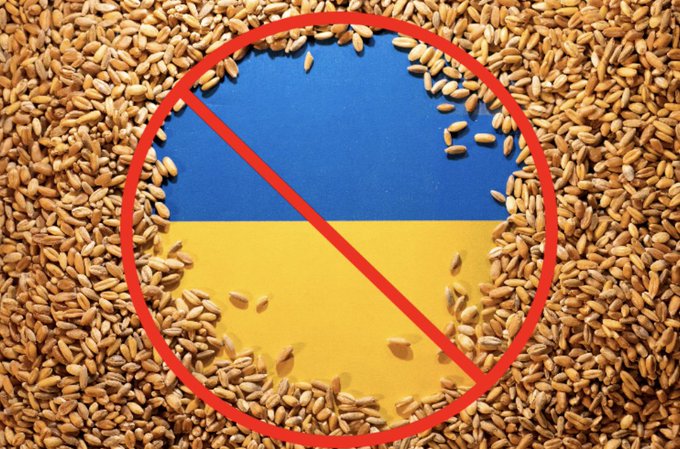
If they're too dangerous for EU countries, they shouldn't be shipped anywhere. Extending the Grain Deal would be harmful.""""""
Yikes, Monsanto's GMO FrankenWHEAT is scary
5 posts • Page 1 of 1
Who is online
In total there are 5737 users online :: 10 registered, 15 bots, and 5712 guests
Registered users: Johnny You, Blackvegetable, Zeets2, ROG62, Beekeeper, jerra b, Cannonpointer, Deezer Shoove, sole, Huey
Bots: ADmantX, SuperBot, Bolt, DuckDuckBot, Googlebot, YandexBot, facebookexternalhit, okhttp, bingbot, proximic, Baiduspider, CriteoBot, curl/7, Applebot, Mediapartners-Google