Flying Monkeys

By Nobody
11 Mar 2011 1:42 pm in No Holds Barred Political Forum
29 Jan 2020 2:38 pm
This puts to rest the myth that the Senate should not call witnesses who did not testify in the House.
From the January 21st transcript of the impeachment trial.
From the January 21st transcript of the impeachment trial.
The Senate has repeatedly subpoenaed and received new documents, often many of them while adjudicating cases of impeachment.
Moreover, the Senate has heard witness testimony in every one of the 15 Senate trials -- full Senate trials in the history of this republic, including those for presidents Andrew Johnson and Bill Clinton.
Indeed, in President Andrew Johnson's Senate impeachment trial, the House managers were permitted to begin presenting documentary evidence to the Senate on the very first day of the trial.
The House managers initial presentation of documents in President Johnson's case carried on for the first two days of the trial, immediately after which witnesses were called to appear in the Senate.
This has been the standard practice in prior impeachment trials.
Indeed, in most trials, this body has heard from many witnesses, ranging from three in President Clinton's case to 40 in President Johnson's and well over 60 in other impeachments.
As these numbers make clear, the Senate has always heard from key witnesses when trying an impeachment.
The notion that only evidence that was taken before the House should be considered is squarely and unequivocally contrary to Senate precedent.
Nothing in law or history supports it.
To start, consider Leader McConnell's own description of his work at a prior Senate impeachment proceeding.
After serving on the Senate Trial Committee in the case of Judge Claiborne, Leader McConnell described how the Senate Committee quote "labored intensively for more than two months, amassing the necessary evidence and testimony."
In the same essay, Leader McConnell recognized the full body's responsibility for amassing and digesting evidence.
There was certainly a lot of evidence for the Senate to amass and digest in that proceeding, which involved charges against the District Court Judge, the Senate heard testimony from 19 witnesses and it allowed for over 2,000 pages of documents to be entered into the record over the course of that trial.
At no point did the Senate limit evidence to what was before the House, it did the opposite, consistent with unbroken Senate practice in every single impeachment trial, every single one.
For example, of the 40 witnesses who testified during President Johnson's Senate trial, only three provided testimony to the House during its impeachment inquiry, only three.
The remaining 37 witnesses in that presidential impeachment trial testified before the Senate.
Similarly, the Senate's full first impeachment trial, which involved charges against Judge Pickering, involved testimony from 11 witnesses, all of whom were new to the impeachment proceedings and not had -- had not testified before the House.
http://www.cnn.com/TRANSCRIPTS/2001/21/se.09.html
29 Jan 2020 2:48 pm
The Democrats forced them to hold a sham trial?Zeets2 » 29 Jan 2020 1:54 pm » wrote:Of course it is! And it was the Democrats that forced them to hold it......Misty » 29 Jan 2020 1:43 pm » wrote:The only you got right is that this is indeed a SHAM trial.

Well at least you admitted that it is a sham trial.
It was NOT hearsay evidence.Zeets2 » 29 Jan 2020 1:54 pm » wrote:.....while knowing full well they could NEVER get Trump removed with the **** pile of hearsay evidence which was all they had!
First of all several people who heard the phone call testified, and secondly, EU Ambassador Gordon Sondland who was in direct communication with Trump testified.
We could have heard from many more first hand witnesses if Sniffles hadn't completely stonewalled Congress.
I guess that little fact just slipped your mind.
29 Jan 2020 4:14 pm
That's because you watch FOX you gaping asshole.Termin8tor » 29 Jan 2020 3:46 pm » wrote:I have yet to see one single thing Fox should carry as news but hasn't.
You have no idea what you are NOT being told.
Oh, I don't know, there's this little thing called an impeachment trial that seems kind of important.Termin8tor » 29 Jan 2020 3:46 pm » wrote:Got an example? No? Or course not.
You don't, so you're lying.
Why are they not airing the whole trial, and why are they telling their viewers that they don't need to watch it because it's too boring?
Never once did I hear anyone on either CNN or MSNBC tell their viewers that it was boring and they shouldn't bother to watch it.On the Wednesday morning edition of Fox & Friends, the co-hosts gave a peculiar message to their viewers about how to watch the crucial events of the Senate impeachment trial against President Donald Trump: Don’t even bother.
“If you watch some of it, there were snippets — and we’re showing you the good stuff — it was unbelievably boring,” said Steve Doocy.
“And I don’t know how people can follow it.”
(MISTY: Does FOX really have so much contempt for their viewers that they think they are too stupid to follow the trial?)
On Tuesday afternoon, Fox anchor Dana Perino declared: “It is somber, it is serious, and I think you could see today, you know, it is a little bit like watching paint dry. …
Things got a lot more explicit on Sean Hannity’s radio show.
Fox News legal analyst Gregg Jarrett appeared as a guest and joked, “I understand there’s a run on NoDoz at Walgreens.”
He characterized the day’s proceedings as “a soporific debate over what procedures to adopt,” adding,
“Frankly, you know, it’s going to be a tepid bore.” (Not exactly the kind of legal analysis that would give people an understanding of what was going on.)
Later in the program, Hannity complained to his producer: “I’m trying to, like, be interested. I’m watching the proceedings.
It is boring me to death what they are doing here today,” and the crew even played a snoring sound effect.
That night, Fox Business host Lou Dobbs brought on longtime Republican strategist Ed Rollins, who said: “It was the longest, most tedious day. I thought I was in, you know, at a graduate course in boring mathematics or something.”
VIDEO and AUDIO
29 Jan 2020 4:26 pm
When did he agree to that? Link?Termin8tor » 29 Jan 2020 4:00 pm » wrote:Hey psycho, it doesn't matter what the Justice Dept says in its motion.Misty » 29 Jan 2020 1:38 pm » wrote:So Trump's lawyers argued this week in the impeachment trial that the House should have fought harder in the courts to enforce their subpoenas and the Senate shouldn't condone their negligence by bringing in new witnesses.
But what they don't tell you is that the DOJ is arguing in court that the House doesn't have any legal grounds to bring lawsuits to enforce subpoenas.
The courts decide, and Roberts agreed to a greatly accelerated schedule.
And even if he did, how long before it gets to the SCOTUS?
McGahn was subpoenaed last March and it hasn't gotten to SCOTUS yet.
Roberts can't rush the lower courts.
29 Jan 2020 8:24 pm
So they're just buying votes now.
Trump allies are handing out cash to black voters
Organizers have begun holding events in black communities where they lavish praise on the president while handing out thousands of dollars in giveaways.
Allies of Donald Trump have begun holding events in black communities where organizers lavish praise on the president as they hand out tens of thousands of dollars to lucky attendees.
The first giveaway took place last month in Cleveland, where recipients whose winning tickets were drawn from a bin landed cash gifts in increments of several hundred dollars, stuffed into envelopes.
A second giveaway scheduled for this month in Virginia has been postponed, and more are said to be in the works.
The tour comes as Trump’s campaign has been investing its own money to make inroads with black voters and erode Democrats’ overwhelming advantage with them.
But the cash giveaways are organized under the auspices of an outside charity, the Urban Revitalization Coalition, permitting donors to remain anonymous and make tax-deductible contributions.
The organizers say the events are run by the book and intended to promote economic development in inner cities.
But the group behind the cash giveaways is registered as a 501(c)3 charitable organization.
One leading legal expert on nonprofit law said the arrangement raises questions about the group’s tax-exempt status, because it does not appear to be vetting the recipients of its money for legitimate charitable need.
"Charities are required to spend their money on charitable and educational activities,” said Marcus Owens, a former director of the Exempt Organizations Division at the Internal Revenue Service who is now in private practice at the law firm Loeb & Loeb.
“It's not immediately clear to me how simply giving money away to people at an event is a charitable act.”
Asked about the legality of the giveaways in a brief phone interview, the Urban Revitalization Coalition’s CEO, Darrell Scott, said that most gifts were between $300 and $500, and that the group mandates that anyone who receives over $600 fills out a W-9 form in order to ensure compliance with tax law.
He did not respond to follow-up questions about how the giveaways were structured and whether they met the legal standard for a charitable act.
Scott declined to name the donors funding the effort.
"I'd rather not,” he said. “They prefer to remain anonymous."
https://www.politico.com/news/2020/01/2 ... ays-108072
30 Jan 2020 9:53 am
A family of grifters.
Every **** one of them.
Every **** one of them.
Melania Trump Is Under Investigation For Engaging In Potentially Illegal Financial Deals
Back in December of 2018, we learned that yet another investigation is now underway into actions taken by Donald Trump and members of his 2016 election team.
The Wall Street Journal reported that federal prosecutors were looking at whether or not foreigners illegally donated to President Trump’s inaugural committee and a pro-Trump Super PAC in the hope of buying influence when it came to American policy.
The New York Times later confirmed the Journal report, noting:
“The inquiry focuses on whether people from Middle Eastern nations — including Qatar, Saudi Arabia and the United Arab Emirates — used straw donors to disguise their donations to the two funds.
Federal law prohibits foreign contributions to federal campaigns, political action committees and inaugural funds.”
But while this new scandal is merely the latest when it comes to possibly illegal activities committed by Donald Trump, it also appears to possibly implicate First Lady Melania Trump.
As was first reported back in February of last year, the Trump inaugural committee paid $26 million — almost a fourth of the $107 million raised for the inauguration — to WIS Media Partners, a company formed in December 2016 and founded by Stephanie Winston Wolkoff, who just so happens to be a close friend of Melania Trump.
Wolkoff’s company was paid that enormous sum for “event production services,” whatever that means.
So the question that logically follows from those facts is: Why did the inaugural committee pay a close friend of the First Lady $26 million?
And the question that comes from that query is this: Did Melania Trump receive anything in return?
Was there a quid pro quo?
While we don’t have access to the inner workings of the investigation of the inaugural committee, former Deputy Attorney General Harry Litman said on MSNBC that the First Lady is facing legal exposure just for the appearance that something shady was behind that $26 million payment.
Oh, and even if the federal investigation goes nowhere thanks to the meddling of Attorney General William Barr, the AG for Washington, D.C. is already issuing subpoenas related to the Trump inaugural, and neither Barr or Trump can interfere with state probes or criminal charges brought by local authorities.
We’ve long known that Donald Trump and his children — who all play a role in his businesses — were in legal jeopardy. And it now appears that the First Lady may be under suspicion for criminal behavior. No matter how you slice it, Melania has a lot of questions to answer.
30 Jan 2020 10:11 am
The Deplorables strike again.
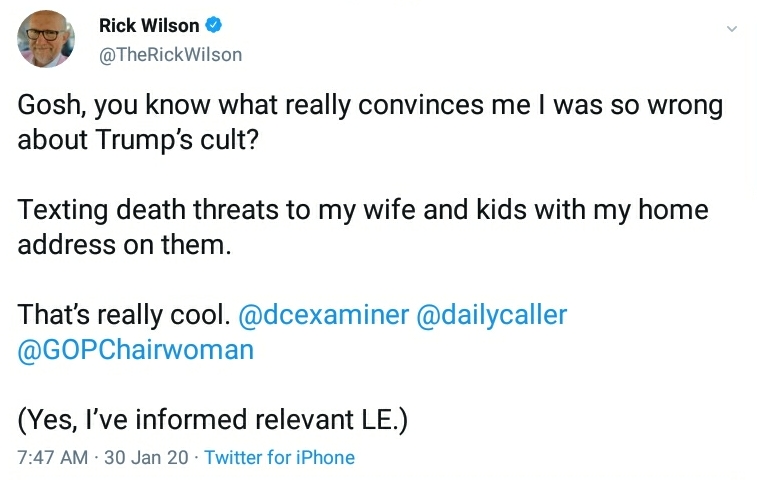
What was Wilson's big crime?
He dared to mock Trump and his followers.
And for that are putting his family in danger.
More proof that Sniffles' followers are a vicious pack of angry jackals.
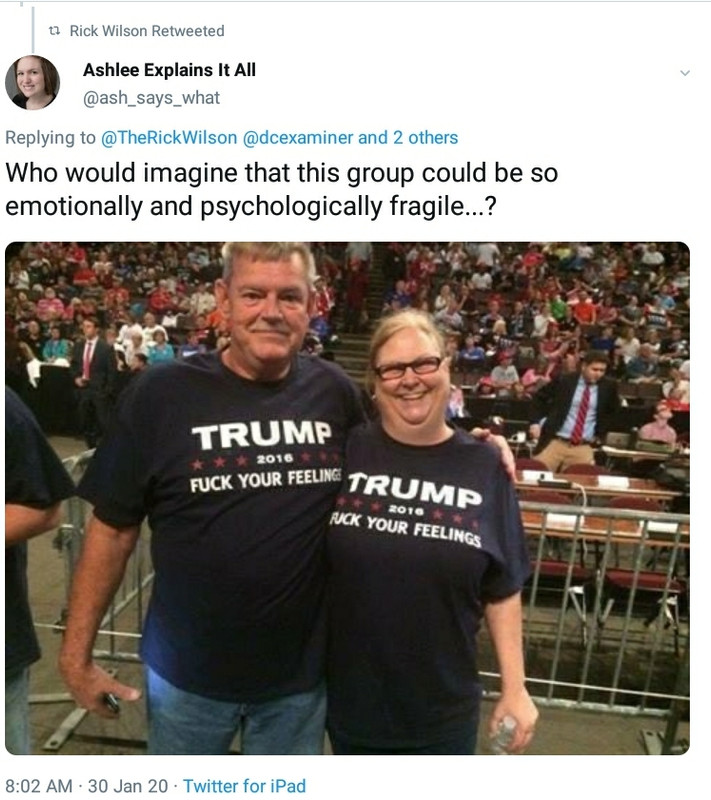
What was Wilson's big crime?
He dared to mock Trump and his followers.
And for that are putting his family in danger.
More proof that Sniffles' followers are a vicious pack of angry jackals.
30 Jan 2020 10:31 am
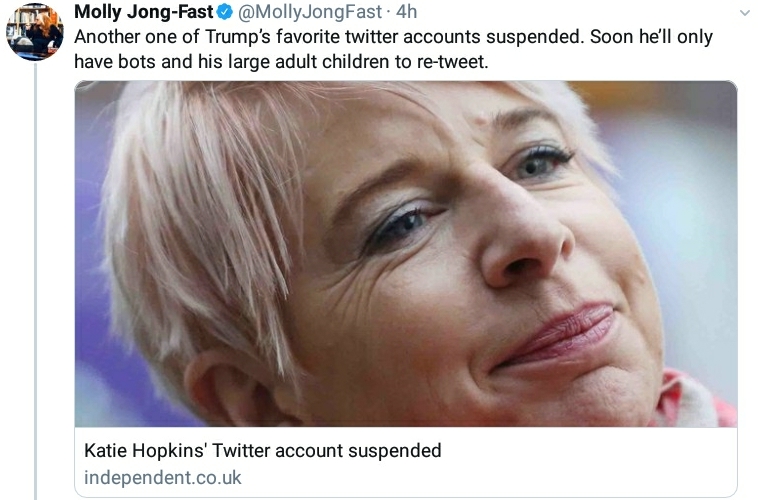
Trump has shared some of her hate filled Tweets, so why has his account not been suspended?Far-right commentator Katie Hopkins has been suspended from Twitter following calls for the social network to carry out a “full review” of her account.
Campaigners had accused her of spreading hate on the platform, where several of her tweets have been shared by Donald Trump, the US president.
Twitter said that Ms Hopkins had been temporarily locked out of her account for violating the site’s hateful-conduct policy, which bans the promotion of violence or inciting harm on the basis of race, religion, national origin or gender identity.
https://www.independent.co.uk/news/uk/h ... 09351.html
30 Jan 2020 11:05 am
Maybe you missed this part.Termin8tor » 30 Jan 2020 10:27 am » wrote:"Deepleftyfield.com?"Misty » 30 Jan 2020 9:53 am » wrote:A family of grifters.
Every **** one of them.
Melania Trump Is Under Investigation For Engaging In Potentially Illegal Financial Deals
Hey, there's a well known credible source.
And "potentially," no less.
From the psychopath who rejects my excellent sources.
You're kidding, right?
The WSJ.The Wall Street Journal reported that federal prosecutors were looking at whether or not foreigners illegally donated to President Trump’s inaugural committee and a pro-Trump Super PAC in the hope of buying influence when it came to American policy.
Isn't that one of the excellent sources you say you use?
https://www.wsj.com/articles/trump-inau ... 1544736455
Anyone who uses Gatewaypundit as a regular source doesn't have a leg to stand on when it comes to anyone else's sources.
Gee, I wonder why in 2018 Melania suddenly dropped her long time friend who got a $26 million inaugural contract?
Why do you think they were so unhappy that the Times broke the story, if there was nothing shady going on?First lady Melania Trump has dropped one of her advisers, Stephanie Winston Wolkoff, after it was revealed that Wolkoff’s firm received a $26 million contract to help plan President Donald Trump’s inauguration last year.
The New York Times reports that the Trumps were not happy when the paper first broke the story about the payment.
Stephanie Grisham, a spokeswoman for the first lady, said Melania Trump “had no knowledge of how funds were spent” with regard to the inauguration of her husband.
https://www.thedailybeast.com/melania-t ... n-contract
ROFL......Melania distanced herself from that **** real quick.
I remember this story about Stephanie Wolkoff and the Inauguration very well.
Like everyone else who gets involved with the Trumps, she has gone down in flames.
Wolkoff started a company just 6 weeks before the Inauguration and she got a $26 million dollar contract?The Rise and Fall of Stephanie Winston Wolkoff
Just a week after the January 20, 2017 inauguration of President Donald Trump, America’s new First Lady, Melania Trump, announced her first hire.
Stephanie Winston Wolkoff, a New York social fixture, event planner, and former Vogue staffer, was brought on as an unpaid advisor to Mrs. Trump, a role which took precedence over traditionally crucial team members such as a chief of staff or social secretary.
[....]
Almost always described as a “longtime friend of the First Lady,” Wolkoff was also one of the key planners for Donald Trump’s 2017 inauguration, and her responsibilities included securing venues and subcontracting out to New York society event planner David Monn.
Her involvement in the inauguration, however, ultimately landed her in hot water.
In late February of this year, The New York Times revealed that WIS Media Partners, a company Wolkoff had started about six weeks before the inauguration, was paid $25.8 million by the president's inaugural committee for its role in planning the event; they were the largest single vendor.
These numbers made headlines because the Trump committee had raised $106.8 million, roughly twice as much as Barack Obama's 2009 committee, and IRS filings showed it spent most of the money on events that were scaled back significantly from past years.
A source told the Times that Wolkoff personally received $1.62 million for her work.
Wolkoff told the paper her firm earned that amount "for all of its consulting and creative services, which was divided among our staff of 15 members (including myself).”
In the wake of the Times story, the First Lady's office publicly announced that it would no longer be working with Wolkoff.
While multiple sources told the paper that the move was specifically prompted by displeasure from the Trumps over the news that Wolkoff’s firm took such a hefty payday, Wolkoff herself rebuts this.
That doesn't smell much.
30 Jan 2020 11:14 am
From my source:Termin8tor » 30 Jan 2020 10:34 am » wrote:I'll bet she didn't tweet any hate. Britain has been assaulting conservative speech for many years now.Misty » 30 Jan 2020 10:31 am » wrote:Katie Hopkins twitter account suspended.
Trump has shared some of her hate filled Tweets, so why has his account not been suspended?
Just like you fascistic leftists want to.
Twitter said that Ms Hopkins had been temporarily locked out of her account for violating the site’s hateful-conduct policy, which bans the promotion of violence or inciting harm on the basis of race, religion, national origin or gender identity.
Twitter is an American social networking service, not a British one you **** jackass.
30 Jan 2020 11:27 am
Trump's followers are a bunch of angry goons.Termin8tor » 30 Jan 2020 10:31 am » wrote:Oh yeah, we're all guilty because of the lunatic acts of a tiny number of people.Misty » 30 Jan 2020 10:11 am » wrote:The Deplorables strike again.
What was Wilson's big crime?
He dared to mock Trump and his followers.
And for that are putting his family in danger.
More proof that Sniffles' followers are a vicious pack of angry jackals.
If anyone dares criticize or mock their dear leader they pounce like an angry mob.
WTF does Carter Page have to do with this?Termin8tor » 30 Jan 2020 10:31 am » wrote:Never saw one single word of concern from you after Carter Page was dishonestly smeared as a Russian agent not by anonymous wackjobs, but by high Obama officials in the most powerful agencies of government.
And FYI, Page was playing footsie with a couple of Russian spies years before Sniffles ever ran for president.
Why Carter Page Was Worth Watching
So **** Carter Page.
Your lack of knowledge on almost every subject is jaw dropping.
Typical FOX News TRUMP TV viewer.
They keep you in the dark on so many important subjects.
30 Jan 2020 12:07 pm
The human penis Florida Senator Rick Scott put out an attack ad in Iowa trashing Joe Biden.
https://youtu.be/8qthGeFGt24
Jake Tapper fact checked the ad, which of course was full of lies.
Scott is the same man who ran a chain of hospitals that paid the largest fine in history for Medicare/Medicaid fraud, and he has the balls to say that Biden is corrupt?
https://www.politifact.com/florida/stat ... icare-fra/
And the son of a bitch sat there and lied with a smile on his face.
https://youtu.be/8qthGeFGt24
Jake Tapper fact checked the ad, which of course was full of lies.
Scott is the same man who ran a chain of hospitals that paid the largest fine in history for Medicare/Medicaid fraud, and he has the balls to say that Biden is corrupt?
https://www.politifact.com/florida/stat ... icare-fra/
And the son of a bitch sat there and lied with a smile on his face.
30 Jan 2020 4:25 pm
This is how stupid Deplorables are.
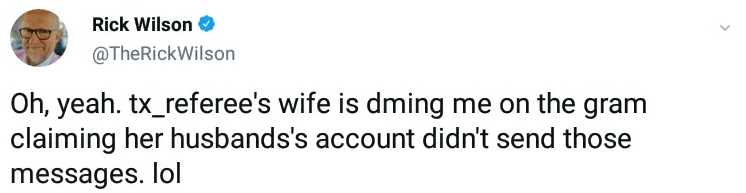
@tx_referee sent a disgusting DM to Rick Wilson on Twitter.
Not realizing that his Twitter profile has personal info about him on it, and his wife's business info.
And Wilson posted the DM on Twitter.
@tx_referees wife is trying to say that her husband didn't send the DM.
And @tx_referees Twitter account has now disappeared.
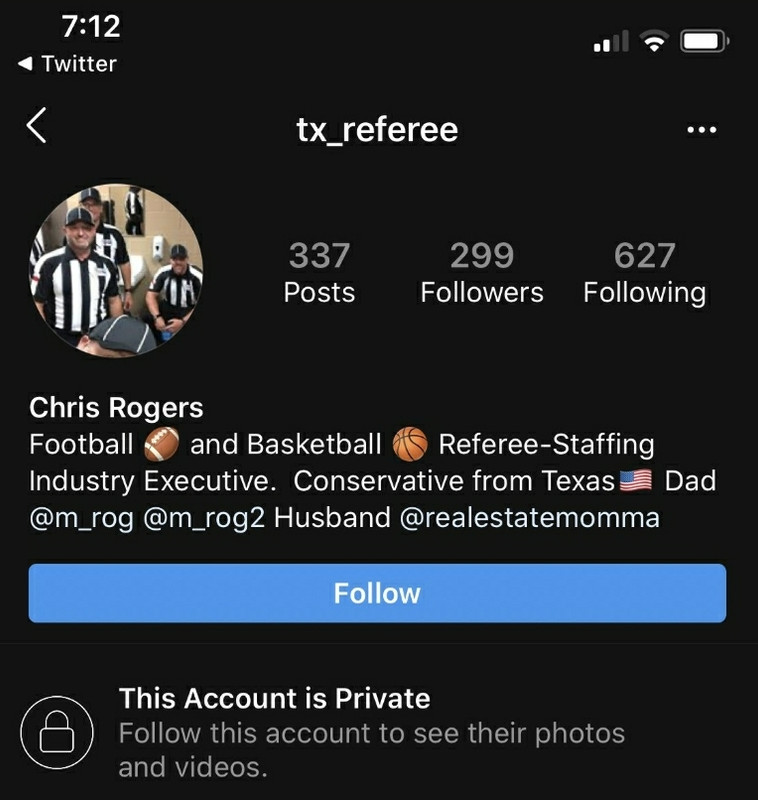

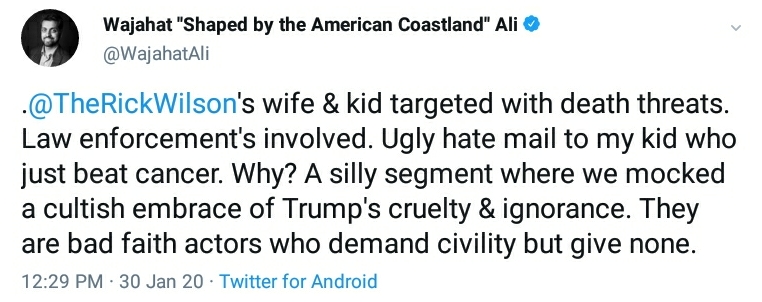
Another person who was on the CNN panel on the night when Rick Wilson had the audacity to mock Trump's followers is also getting hateful messages.
@tx_referee sent a disgusting DM to Rick Wilson on Twitter.
Not realizing that his Twitter profile has personal info about him on it, and his wife's business info.
And Wilson posted the DM on Twitter.
@tx_referees wife is trying to say that her husband didn't send the DM.
And @tx_referees Twitter account has now disappeared.
Another person who was on the CNN panel on the night when Rick Wilson had the audacity to mock Trump's followers is also getting hateful messages.
30 Jan 2020 4:32 pm
One of the best movie scenes of all time, but the best part is cut off in your video.
https://m.youtube.com/watch?v=sA0glbG6c ... dex=2&t=0s
30 Jan 2020 5:56 pm
There is only one reason at this point to out the whistleblower's name.Why Chief Justice Roberts refused to read a question from Rand Paul at Trump’s trial.
Chief Justice John Roberts on Thursday refused to read a question from Sen. Rand Paul that appeared intended to out the whistleblower whose complaint eventually led to the impeachment investigation.
“The presiding officer declines to read the question as submitted,” said Roberts, after Paul offered the written question.
Paul’s inquiry, according to tweets he later posted, focused on the relationship between a staffer at the House Intelligence Committee and someone he may have worked with at the National Security Council, naming two specific individuals. He went on to add that he had no “independent information” about who the whistleblower was.
“I think this is an important question, one that deserves to be asked. It makes no reference to anybody who may or may not be a whistleblower,” Paul told reporters at a press briefing. One of the names he mentions, however, has been floated by some conservative publications as the potential whistleblower.
It’s the second time in the Senate’s two days of questioning that this scenario has played out; on Wednesday, Roberts told lawmakers that he would not read questions that could include the identity of a whistleblower, seemingly dismissing a submission from Paul, according to Politico.
Paul is among the members of the GOP who’ve been eager to use the focus on the whistleblower to divert attention from the abuse of power Trump is charged with committing. “Do your job and print his name!” Paul yelled at the press during a rally last fall.
Revenge.
His or her life would be in danger from Trump's angry mob of goons, and would be basically destroyed.
And all for doing the right thing.
30 Jan 2020 11:00 pm
30 Jan 2020 11:37 pm
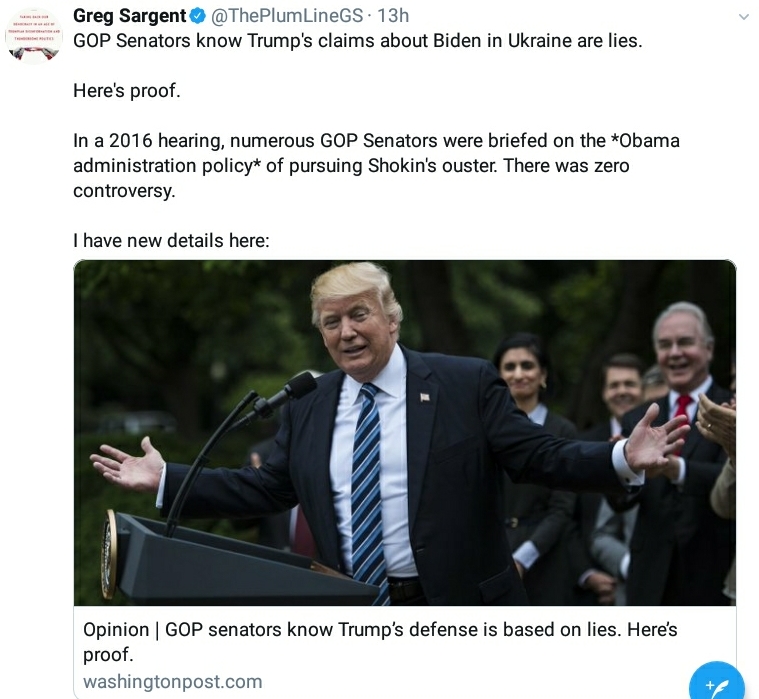
GOP senators know Trump’s defense is based on lies. Here’s proof.
As President Trump’s trial hurtles toward a vote on new witnesses, his lawyers have based his defense in part on the notion that Trump’s demand that Ukraine investigate the Bidens was legitimate.
A core claim from Trump’s team has been that Trump had at least some reason to suspect there was something untoward about Joe Biden’s efforts as vice president to oust a Ukrainian prosecutor.
They’ve cited two facts — that Biden threatened to withhold loan guarantees from Ukraine to leverage that ouster and that Biden’s son Hunter sat on the board of Ukrainian company Burisma — which they claim presented a potential conflict of interest.
That made Trump’s suspicions reasonable, they say.
But Republican senators themselves know this argument is nonsense.
And here’s how we can be certain they know this.
At a Senate hearing in 2016, a number of GOP senators who are still in office today sat in attendance during discussions of the Obama administration’s approach to Ukraine.
At those hearings, officials and outside experts repeatedly discussed the need to remove the prosecutor in question — Viktor Shokin, the prosecutor general — describing this imperative as central to official U.S. policy.
What’s more, Joe Biden’s own role in prompting this ouster came up repeatedly, and it was openly and explicitly discussed that the loan guarantees were being used as leverage to bring it about — as U.S. policy.
None of this was treated as remotely controversial at the time.
Ever since we learned that Trump and personal lawyer Rudolph Giuliani sought to pressure Ukraine into announcing a sham investigation that would smear the Bidens, Trump’s defenders have continued to assert that Biden’s conduct in Ukraine was suspicious at best, and scandalously corrupt at worst.
Trump defenders have noted that Biden boasted in a January 2018 speech about withholding a loan guarantee to bring about Shokin’s ouster, and that, given Hunter’s role on Burisma’s board, this showed Biden engaged in his own corrupt quid pro quo.
This whole narrative is based on lies.
In recent months, news organizations have convincingly established — in retrospect — that ousting Shokin was U.S. policy at the time, backed by international institutions, because his office was actually facilitating corruption.
They’ve also established that Hunter was irrelevant to the investigation into Burisma and that this probe was dormant at the time of the pressure to oust Shokin.
But, crucially, the public record at the time also shows that the ouster of Shokin, including the use of loan guarantees as leverage, was U.S. policy — and that at least some Republican senators knew all of this as it was happening.
GOP senators have long known this was uncontroversial.
At a Senate Foreign Relations Committee hearing in March 2016, Victoria Nuland, the assistant secretary of state under President Barack Obama, testified about efforts to oust Shokin.
Nuland noted that Shokin had resigned but that the Ukrainian parliament still had to remove him (which happened soon after).
Nuland also told senators that the agenda of the United States’ aid program for Ukraine, with the “generous support” of Congress, included replacing Shokin, for the good of fighting corruption in Ukraine.
Nuland noted it was a U.S. priority to secure a “new prosecutor general who is committed” to “indicting and prosecuting the corrupt.”
Nuland also cited the loan guarantee as leverage.
“We have pegged our next $1 billion loan guarantee” in part on “ensuring that the prosecutor general’s office gets cleaned up,” Nuland said.
Biden comes up at hearing
Biden also came up repeatedly at this hearing.
Nuland explicitly noted that Biden himself had conditioned U.S. support for Ukraine on getting rid of that prosecutor as a matter of U.S. policy.
She cited a speech that Biden had given in Ukraine a few months earlier, in which Biden declared: “The office of the General Prosecutor desperately needs reform.”
In reference to that speech, Nuland told senators that Biden had publicly declared that this reform is "what our support depends on.”
GOP senators present at the hearing — and who remain in office today — included John Barrasso (Wyo.), Cory Gardner (Colo.), James E. Risch (Idaho) and David Perdue (Ga.).
What this shows is that ousting the prosecutor was about fighting corruption in Ukraine as a matter of administration policy — and that GOP senators understood this full well at the time. Indeed, none of that stirred any controversy.
Shokin comes up at another hearing
At a Senate Foreign Relations Committee hearing in October 2015, before Shokin was removed, Nuland stated it was U.S. policy to target Shokin.
Nuland said the United States was pursuing “a cleanup of the prosecutor general’s office so that it begins to serve the Ukrainian people rather than ripping them off.”
Nuland added this was being done with the help of “European advisers,” and that the administration’s anti-corruption efforts in Ukraine had the support of the International Monetary Fund.
Gardner was present at this hearing.
It was already known to some degree that a few GOP senators at the time supported the administration’s efforts to clean up Shokin’s office.
A February 2016 letter signed by Sens. Rob Portman (Ohio) and Ron Johnson (Wis.) called for such reforms.
That GOP senators were present at hearings where this was extensively discussed as administration policy underscores this further.
Trump’s bogus defense
The idea that Trump had reasonable cause for concern about Biden’s activities in Ukraine is central to justifying his pressure on Ukrainian President Volodymyr Zelensky to announce a sham investigation of those activities.
As Trump’s legal brief argues, it was “legitimate” for Trump to bring this up with Zelensky, because “Biden threatened withholding U.S. loan guarantees” to secure Shokin’s dismissal “even though Biden was, at the time, operating under what appeared to be, at the very least, a serious conflict of interest.”
That conflict, of course, is supposedly that Hunter was sitting on Burisma’s board.
But as GOP senators themselves well know, having been briefed on the policy at the time, that wasn’t motivating the policy in the least.
It has been public since 2014 that Hunter got the Burisma gig.
GOP senators should be challenged to point to any examples of them raising alarms about any of this at the time.
The real story is that the Hunter story has been reverse-grafted by Trump and Giuliani on to Joe Biden’s activities, to create a fake rationale for getting Ukraine to smear Biden.
The idea that Trump was concerned about corruption has always been absurd, given that he only demanded investigations that would help him politically, as if that was pure coincidence.
Indeed, it’s even more absurd than this.
As James Risen has detailed, in 2015, U.S. officials criticized the Ukrainian prosecutor general’s office for failing to assist with a British investigation into Burisma’s owner, which cuts directly against the nonsense that this was a corrupt effort to help Burisma (or Hunter).
The bottom line is that it was not legitimate for Trump to claim Biden’s effort to oust Shokin was linked to Hunter’s Burisma gig to justify his corrupt demand of Zelensky.
To allow Trump to make this legitimate simply by saying there might have been such a link is to concede to him the power to rewrite reality with disinformation, all to justify his extortion of a foreign power to help him cheat his way through the next election.
GOP senators who know better might be prepared to concede that power to him.
But we don’t have to.
https://www.washingtonpost.com/opinions ... iQMCRZHS8C
30 Jan 2020 11:46 pm


31 Jan 2020 12:32 pm

Fox viewers know about how corrupt Trump FBI officials framed decorated General Flynn on false charges.
You are a PROVEN LIAR a GUTLESS COWARD and a TRAITOR. I have shown you before that Flynn was NOT FRAMED. He ADMITTED in sworn statement to the court that he lied to the FBI he admitted in OPEN COURT to the judge that he KNEW he was committing a CRIME WHEN he lied to the FBI. You are such a TRAITOR you attack the FBI for investigating a MAN WHOS IS GUILTY. The judge has already RULED he was not framed
https://www.usatoday.com/story/news/politics/2019/12/16/michael-flynn-judge-rejects-claims-fbi-doj-framed-him/2667201001/
Judge rejects Michael Flynn's claims of a government conspiracy to frame him
WASHINGTON — A federal judge rejected claims by former national security adviser Michael Flynn that government prosecutors forced him to plead guilty to crimes he did not commit and then hid evidence that would've exonerated him.
In his ruling, Sullivan said "it is undisputed" that Flynn made false statements to the FBI, as well as to Vice President Mike Pence and senior White House officials, "who, in turn, repeated Mr. Flynn's false statements to the American people on national television."
Sullivan rejected Flynn's claim that the FBI conducted an ambush interview in order to trap him into making false statements.
"The record proves otherwise," Sullivan wrote. "The sworn statements of Mr. Flynn and his former counsel belie his new claims of innocence and his new assertion that he was pressured into pleading guilty to making materially false statements to the FBI."
The documents Flynn seeks
do not exist, are not in prosecutors' hands, or are unrelated to the crime he pleaded guilty to committing, the judge wrote. And some of the documents he's seeking have already been provided to him, Sullivan wrote
https://www.politifact.com/truth-o-meter/statements/2019/mar/28/donald-trump/no-fbi-did-not-say-michael-flynn-did-not-lie-donal/
Your sources are covering it up.
There is no cover up only YOU telling LIES and spewing your DELUSIONAL FANTASIES. The media does not have an obligation to report your DELUSIONAL FANTASIES or your LIES for Russia
ADDRESS the FACTS or STFU you GUTLESS COWARD and TRAITOR
31 Jan 2020 12:45 pm
As E.U. Ambassador Gordon Sondland said, "EVERYBODY WAS IN THE LOOP."
Even, according to Bolton's book, WH Counsel Pat Cipollone, who is now a part of Trump's defense team.
You seriously can't make this **** up.
Even, according to Bolton's book, WH Counsel Pat Cipollone, who is now a part of Trump's defense team.
You seriously can't make this **** up.
Trump Told Bolton to Help His Ukraine Pressure Campaign, Book Says
The president asked his national security adviser last spring in front of other senior advisers to pave the way for a meeting between Rudolph Giuliani and Ukraine’s new leader.
More than two months before he asked Ukraine’s president to investigate his political opponents, President Trump directed John R. Bolton, then his national security adviser, to help with his pressure campaign to extract damaging information on Democrats from Ukrainian officials, according to an unpublished manuscript by Mr. Bolton.
Mr. Trump gave the instruction, Mr. Bolton wrote, during an Oval Office conversation in early May that included the acting White House chief of staff, Mick Mulvaney, the president’s personal lawyer Rudolph W. Giuliani and the White House counsel, Pat A. Cipollone, who is now leading the president’s impeachment defense.
Mr. Trump told Mr. Bolton to call Volodymyr Zelensky, who had recently won election as president of Ukraine, to ensure Mr. Zelensky would meet with Mr. Giuliani, who was planning a trip to Ukraine to discuss the investigations that the president sought, in Mr. Bolton’s account. Mr. Bolton never made the call, he wrote.
The previously undisclosed directive that Mr. Bolton describes would be the earliest known instance of Mr. Trump seeking to harness the power of the United States government to advance his pressure campaign against Ukraine, as he later did on the July call with Mr. Zelensky that triggered a whistle-blower complaint and impeachment proceedings.
House Democrats have accused him of abusing his authority and are arguing their case before senators in the impeachment trial of Mr. Trump, whose lawyers have said he did nothing wrong.
The account in Mr. Bolton’s manuscript portrays the most senior White House advisers as early witnesses in the effort that they have sought to distance the president from.
And disclosure of the meeting underscores the kind of information Democrats were looking for in seeking testimony from his top advisers in their impeachment investigation, including Mr. Bolton and Mr. Mulvaney, only to be blocked by the White House.
In a statement after this article was published, Mr. Trump denied the discussion that Mr. Bolton described.
“I never instructed John Bolton to set up a meeting for Rudy Giuliani, one of the greatest corruption fighters in America and by far the greatest mayor in the history of N.Y.C., to meet with President Zelensky,” Mr. Trump said.
“That meeting never happened.”
In a brief interview, Mr. Giuliani denied that the conversation took place and said those discussions with the president were always kept separate.
He was adamant that Mr. Cipollone and Mr. Mulvaney were never involved in meetings related to Ukraine.
“It is absolutely, categorically untrue,” he said.
Neither Mr. Bolton nor a representative for Mr. Mulvaney responded to requests for comment.
Mr. Bolton described the roughly 10-minute conversation in drafts of his book, a memoir of his time as national security adviser that is to go on sale in March.
Over several pages, Mr. Bolton laid out Mr. Trump’s fixation on Ukraine and the president’s belief, based on a mix of scattershot events, assertions and outright conspiracy theories, that Ukraine tried to undermine his chances of winning the presidency in 2016.
As he began to realize the extent and aims of the pressure campaign, Mr. Bolton began to object, he wrote in the book, affirming the testimony of a former National Security Council aide, Fiona Hill, who had said that Mr. Bolton warned that Mr. Giuliani was “a hand grenade who’s going to blow everybody up.”
Mr. Trump also repeatedly made national security decisions contrary to American interests, Mr. Bolton wrote, describing a pervasive sense of alarm among top advisers about the president’s choices.
Mr. Bolton expressed concern to others in the administration that the president was effectively granting favors to autocratic leaders like Recep Tayyip Erdogan of Turkey and Xi Jinping of China.
The New York Times reported this week on another revelation from Mr. Bolton’s book draft: that Mr. Trump told him in August that he wanted to continue freezing $391 million in security assistance to Ukraine until officials there helped with investigations into Democrats including former Vice President Joseph R. Biden Jr. and his son Hunter.
That account undercuts a key element of the White House impeachment defense — that the aid holdup was separate from his requests for inquiries. Mr. Trump has denied the conversation took place.
Since that Times article, people who have reviewed the draft have further described its contents, including details of the May meeting.
Mr. Bolton’s manuscript was sent to the White House for a standard review process in late December.
Its revelations galvanized the debate over whether to call witnesses in the impeachment trial, but late on Thursday, Republicans appeared to have secured enough votes to keep any new testimony out of Mr. Trump’s trial and to move toward a quick acquittal in the third presidential impeachment trial in American history.
The White House has sought to block the release of the book, contending that it contains classified information.
The government reviews books by former officials who had access to secrets so they can excise the manuscripts of any classified information.
Officials including Mr. Trump have described Mr. Bolton, who was often at odds with Secretary of State Mike Pompeo and Mr. Mulvaney, as a disgruntled former official with an ax to grind.
Mr. Bolton has angered Democrats — and some Republicans — for remaining quiet during the House investigation, then announcing that he would comply with any subpoena to testify in the Senate and signaling that he is eager to share his story.
Administration officials should “feel they’re able to speak their minds without retribution,” he said at a closed-door lunch in Austin, Texas, on Thursday, the NBC affiliate KXAN reported, citing unnamed sources.
“The idea that somehow testifying to what you think is true is destructive to the system of government we have — I think, is very nearly the reverse, the exact reverse of the truth,” Mr. Bolton added.
The Oval Office conversation that Mr. Bolton described came as the president and Mr. Giuliani were increasingly focusing on pushing the Ukrainian government to commit to investigations that could help Mr. Trump politically.
At various points, Mr. Trump, Mr. Giuliani and their associates pressed Ukrainian officials under Mr. Zelensky and his predecessor to provide potentially damaging information on the president’s rivals, including Mr. Biden and Ukrainians who Mr. Trump’s allies believed tried to help Hillary Clinton in 2016.
Mr. Giuliani had just successfully campaigned to have the American ambassador to Ukraine, Marie L. Yovanovitch, recalled, convinced that she was part of an effort to protect Mr. Trump’s political rivals from scrutiny.
Mr. Giuliani had argued she was impeding the investigations.
At the time of the Oval Office conversation Mr. Bolton wrote about, Mr. Giuliani was planning a trip to Kyiv to push the incoming government to commit to the investigations.
Mr. Giuliani asserted that the president had been wronged by the Justice Department’s Russia investigation and told associates that the inquiry could be partly discredited by proving that parts of it originated with suspect documents produced and disseminated in Ukraine to undermine his onetime campaign chairman, Paul Manafort, whose work in Ukraine became a central focus of the Russia inquiry.
Mr. Giuliani, a private consultant with a range of international clients, had said none were involved in the Ukraine effort, Mr. Bolton wrote, adding that he was skeptical and wanted to avoid involvement.
At the time, Mr. Giuliani was working closely with two Soviet-born businessmen from Florida, Lev Parnas and Igor Fruman, to carry out the shadow Ukraine effort.
After pushing out Ms. Yovanovitch, Mr. Giuliani turned his attention to other American diplomats responsible for Ukraine policy.
During the Oval Office conversation, he also mentioned a State Department official with the last name of Kent, whom Mr. Bolton wrote he did not know.
Mr. Giuliani said he was hostile to Mr. Trump and sympathetic to George Soros, the billionaire philanthropist who has long been a target of the far right.
George P. Kent, a top State Department official who oversees Ukraine policy, went on to be a key witness in House Democrats’ impeachment investigation, testifying that claims by Mr. Giuliani’s allies of Mr. Soros’ wide influence in Ukraine were used to smear Ms. Yovanovitch.
Mr. Bolton left the Oval Office after 10 minutes and returned to his office, he wrote.
Shortly after, two aides came into his office, saying Mr. Trump had sent them out of a separate meeting on trade to ask about Mr. Kent, Mr. Bolton wrote.
The conversation that Mr. Bolton describes was separate from another one that Mr. Bolton wrote about, where he observed Mr. Mulvaney and Mr. Trump talking on the phone with Mr. Giuliani about Ukraine matters.
Mr. Mulvaney has told associates he would leave the room when Mr. Trump and Mr. Giuliani were talking to preserve their attorney-client privilege, and his lawyer said earlier this week that Mr. Mulvaney was never in meetings with Mr. Giuliani and has “no recollection” of the first discussion.
Around the time of the May discussion, The Times revealed Mr. Giuliani’s efforts and his planned trip to Ukraine.
Mr. Giuliani said at the time that Mr. Trump was aware of his efforts in Ukraine, but said nothing else about any involvement of Mr. Trump or other members of the administration.
The disclosure created consternation in the White House and Mr. Giuliani canceled his trip.
A day after the Times article was published, Mr. Giuliani wrote a letter to Mr. Zelensky, saying he was representing Mr. Trump as a “private citizen” and, with Mr. Trump’s “knowledge and consent,” hoped to arrange a meeting with Mr. Zelensky in the ensuing days.
That letter was among the evidence admitted during the House impeachment inquiry.
Who is online
In total there are 6289 users online :: 18 registered, 14 bots, and 6257 guests
Registered users: Vegas, Johnny You, *Roshambo, Blackvegetable, Zeets2, Squatchman, Buffalo, ROG62, RebelGator, ConservativeWave, MR-7, Beekeeper, PhiloBeddo, Cannonpointer, Deezer Shoove, nefarious101, sole, Fuelman
Bots: FDM, DuckDuckGo, ADmantX, LCC, DuckDuckBot, YandexBot, proximic, CriteoBot, Baiduspider, Mediapartners-Google, bingbot, curl/7, Googlebot, Applebot