Flying Monkeys

By Nobody
11 Mar 2011 1:42 pm in No Holds Barred Political Forum
18 Aug 2020 12:54 pm
You lie as much as your Dear Leader does.duck615 » 18 Aug 2020, 12:51 pm » wrote: ↑**** youMisty » 18 Aug 2020, 12:25 pm » wrote: ↑I see you're out of the Dungeon Ducky Boy.
Can you quote her calling for violence you degenerate liar?
Of course you can't.
you never prove ****

18 Aug 2020 2:05 pm
Bite me.duck615 » 18 Aug 2020, 1:33 pm » wrote: ↑Well bitch until you tell me why I was sent 2 the dungeon...
18 Aug 2020 2:33 pm
Cry me a **** river.duck615 » 18 Aug 2020, 2:24 pm » wrote: ↑So you are just another liberal bitch abusing her mod powers... Got it!
You contribute nothing to this forum.
If it were up to me you would have been banned a long time ago.
18 Aug 2020 7:16 pm
Six revelations in Senate intel report on 2016 Russian interference.
1. Trump’s campaign chairman was consorting with a Russia spy.
The report says — in a first — that Konstantin Kilimnik, an associate of then-Trump campaign chairman Paul Manafort, was a “Russian intelligence officer.” It also says Manafort was meeting regularly and sharing information with Kilimnik, including internal Trump campaign polling data.
But because the men used encrypted communications, and because Manafort never truly cooperated with investigators, the committee was unable to determine exactly what the pair were up to.
The report says there is information, blacked out in the document, suggesting both Kilimnik and Manafort may have had some link to the Russian operation to steal and leak Democratic emails. Whatever it was, it wasn’t enough for Mueller to bring charges.
That fact pattern alone led the committee to label Manafort, who is serving prison time for unrelated offenses, a "grave counterintelligence threat.” Whether he actually “colluded” with the 2016 Russian intelligence operation may never be determined.
2. Trump almost certainly talked to Roger Stone about Wikileaks.
The committee — including some key Trump allies — determined that Trump knew his campaign was communicating about Wikileaks, even though he told Mueller he didn’t recall that.
Trump, in written responses to the special counsel’s office, stated: "I do not recall discussing WikiLeaks with [Stone], nor do I recall being aware of Mr. Stone having discussed WikiLeaks with individuals associated with my campaign."
Trump further claimed that he had "no recollection of the specifics of any conversations I had with Mr. Stone between June 1, 2016 and November 8, 2016."
Despite Trump's recollection, the report says, “the Committee assesses that Trump did, in fact, speak with Stone about WikiLeaks and with members of his Campaign about Stone's access to WikiLeaks on multiple occasions.”
That puts Trump in the middle of his campaign’s eager embrace of material he knew had been stolen by a foreign intelligence agency.
The report doesn’t accuse Trump of lying, but it lays out a pattern of discussions with Stone that makes it difficult to believe Trump didn’t remember.
3. The dossier by a British intelligence officer was deeply flawed.
The Senate investigation didn’t try to verify or disprove the allegations included in the Steele dossier, a set of memos about Trump compiled by former British spy Christopher Steele, but it did examine Steele’s work process and whether the FBI should have viewed the dossier credibly.
The committee found that Steele’s tradecraft in the dossier was “generally poor” compared to the intelligence community’s standards, often relying on sources “several steps removed from the information they provided.”
The senators also said there were “several opportunities for interested parties to insert disinformation” – a conclusion that buttresses concerns that elements of Russian disinformation may have made their way into the dossier amid other accurate portions.
4. Two participants in the Trump Tower meeting had extensive Russian connections.
At least two participants in the June 9, 2016 meeting between Trump campaign officials and Russians in the Trump Tower had “significant connections to the Russian government, including Russian intelligence services… far more extensive than what had been publicly known.”
Although the meeting was set up to deliver dirt on Clinton to the Trump campaign, no such information was transmitted, the committee found.
But the committee assessed that two participants in the meeting, Natalia Veselnitskaya and Rinat Akhmetshin, have "significant connections to the Russian government, including the Russian intelligence services."
At least two participants in the June 9, 2016 meeting between Trump campaign officials and Russians in the Trump Tower had “significant connections to the Russian government, including Russian intelligence services… far more extensive than what had been publicly known.”
Although the meeting was set up to deliver dirt on Clinton to the Trump campaign, no such information was transmitted, the committee found.
But the committee assessed that two participants in the meeting, Natalia Veselnitskaya and Rinat Akhmetshin, have "significant connections to the Russian government, including the Russian intelligence services."
5. The idea that Ukraine interfered in the campaign originated with Russian intelligence.
Kilimnick, a Russian intelligence operative, “almost certainly helped arrange some of the first public messaging” that Ukraine interfered in the election, an idea that Trump embraced, the report said.
One example cited was his email to a Financial Times reporter, who subsequently wrote a story headlined, “Ukraine's leaders campaign against 'pro-Putin' Trump.”
6. Carter Page may have been wronged by the FBI, but the committee found him suspicious.
The Justice Department inspector general found that the FBI made serious errors in applying for surveillance on Page, a former Trump campaign aide, and an FBI lawyer had admitted to a crime as a result.
Page was never charged in the investigation, but the committee was not pleased with what he had to say to lawmakers.
FBI scrutiny of Page was justified, the report says.
"The Committee had significant challenges in its attempt to understand Page's activities, including his role as a foreign policy adviser to the Trump Campaign.
After weeks of negotiation and an eventual Committee subpoena, Page produced some electronic documents, some of which included his own annotations and alterations to the original document form, and sat for an interview that lasted six and a half hours."Page's responses to basic questions were meandering, avoidant, and involved several long diversions.
Despite the meticulous records Page kept on his personal hard drive detailing his daily routines, he was unable to recall any details of his trips to Moscow, or the names of senior Russian officials with whom he met, despite using his engagements with them to build his credentials within the Campaign."
In a footnote, the report adds, “The Carter Page FISA order and renewals are examined in detail in the DOJ OIG FISA Report.
While there were several problems with the FBI's FISA renewals for Page, the Committee assesses that Page's previous ties to Russian intelligence officers, coupled with his Russian travel, justified the FBI's initial concerns about Page."
https://www.nbcnews.com/politics/nation ... e-n1237184
18 Aug 2020 7:21 pm
So it turns out that Trump issued a pardon to Susan B. Anthony.
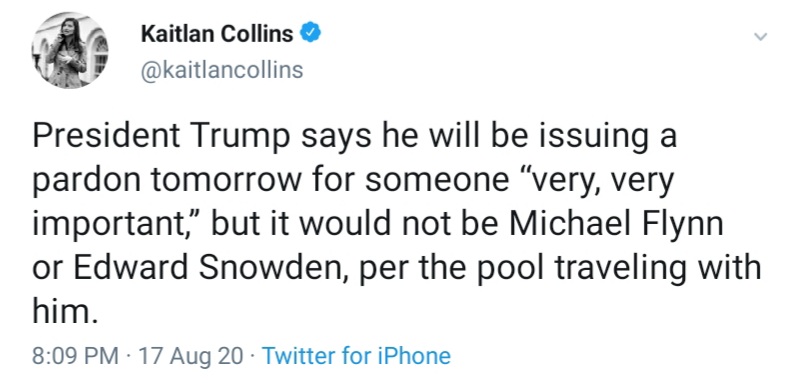
How very, very important.

18 Aug 2020 7:26 pm
The only point you have is the one on the top of your head.duck615 » 18 Aug 2020, 3:23 pm » wrote: ↑thank you for proving my point...Misty » 18 Aug 2020, 2:33 pm » wrote: ↑ Cry me a **** river.
You contribute nothing to this forum.
If it were up to me you would have been banned a long time ago.
You repeat that same **** 50 times a day.

19 Aug 2020 11:11 am

19 Aug 2020 1:20 pm
Yeah, Good luck with that.Termin8tor » 19 Aug 2020, 1:02 pm » wrote: ↑If it gets him half a point among suburban women, it is.So it turns out that Trump issued a pardon to Susan B. Anthony.
How very, very important.

I can hardly wait to see that Sandmann kid and the St. Louis gun brandishing couple.
Will Chachi, Chuck Woolery and the MyPillow guy also be featured?
I never saw a convention like the DNC with so many speakers endorsing a candidate from another party.
Do you think any Democrats will endorse Trump at the RNC?
Why no comment on my post #21,318 Precious?
You never miss one of my posts.

19 Aug 2020 1:25 pm

That and reversing Obama's federal assault on the suburbs will gain him a lot of votes with suburban women, psycho.Misty » 19 Aug 2020, 1:20 pm » wrote: ↑Yeah, Good luck with that.Termin8tor » 19 Aug 2020, 1:02 pm » wrote: ↑I can hardly wait to see that Sandmann kid and the St. Louis gun brandishing couple.
Will Chachi, Chuck Woolery and the MyPillow guy also be featured?
You have no clue about that, of course.
.
Yeah, Trump should feature serial rapists, criminals and anti-semites as speakers, like Biden did.I can hardly wait to see that Sandmann kid and the St. Louis gun brandishing couple.
Will Chachi, Chuck Woolery and the MyPillow guy also be featured?
19 Aug 2020 1:28 pm
.Misty » 19 Aug 2020, 1:20 pm » wrote: ↑
I never saw a convention like the DNC with so many speakers endorsing a candidate from another party.
Do you think any Democrats will endorse Trump at the RNC?
A bunch of liberals and washed up hacks like Kasich?
Gosh, I won't be able to sleep tonight. They tried that last time.

But the fact that roughly 25% of attendees at Trump rallies were Democrats as well as many independents and non-voting Republicans ought to keep you up at night.
19 Aug 2020 1:32 pm
Here's a hint, psycho. Russian spies don't approach people and say,"Hi,I'm a Russian spy."Misty » 18 Aug 2020, 7:16 pm » wrote: ↑Six revelations in Senate intel report on 2016 Russian interference.
1. Trump’s campaign chairman was consorting with a Russia spy.
Imbecile.
And the Senate cleared Trump and his campaign.
But HRC did collude with the Russians to spread Russian disinformation via the Steele Dossier.
You'll censor the truth, of course.
19 Aug 2020 1:45 pm
So you think that Paul Manafort didn't know who he was dealing with?Termin8tor » 19 Aug 2020, 1:32 pm » wrote: ↑Here's a hint, psycho. Russian spies don't approach people and say,"Hi,I'm a Russian spy."Misty » 18 Aug 2020, 7:16 pm » wrote: ↑Six revelations in Senate intel report on 2016 Russian interference.
1. Trump’s campaign chairman was consorting with a Russia spy.
Imbecile.
And the Senate cleared Trump and his campaign.
But HRC did collude with the Russians to spread Russian disinformation via the Steele Dossier.
You'll censor the truth, of course.
The Senate said that Trump most likely lied to Mueller about his knowledge of the WikiLeaks email releases.
And then there is this:
Senate committee made criminal referral of Trump Jr., Bannon, Kushner, two others to federal prosecutors.
It wasn't a hoax and it wasn’t a witch hunt Precious.
They were all soliciting and/or accepting help from a foreign adversary and lying about it.
19 Aug 2020 1:59 pm
SENATE INTELLIGENCE COMMITTEE BIPARTISAN RUSSIA REPORT
VOLUME V, PAGE 8
(U) Trump and senior Campaign officials sought to obtain advance information about WikiLeaks's planned releases through Roger Stone.
At their direction, Stone took action to gain inside knowledge for the Campaign and shared his purported knowledge directly with Trump and senior Campaign officials on multiple occasions.
Trump and the Campaign believed that Stone had inside information and expressed satisfaction that Stone's information suggested more releases would be forthcoming.
VOLUME V, PAGE 8
(U) Trump and senior Campaign officials sought to obtain advance information about WikiLeaks's planned releases through Roger Stone.
At their direction, Stone took action to gain inside knowledge for the Campaign and shared his purported knowledge directly with Trump and senior Campaign officials on multiple occasions.
Trump and the Campaign believed that Stone had inside information and expressed satisfaction that Stone's information suggested more releases would be forthcoming.
20 Aug 2020 12:49 pm
20 Aug 2020 1:18 pm
Of course Mark Levin would feed you that ****.Termin8tor » 20 Aug 2020, 1:02 pm » wrote: ↑As Mark Levin and other conservatives have pointed out, the Senate Intelligence Committee is a rotten part of the Swamp, even with Burr gone.
Marco Rubio, James Risch, Susan Collins, Roy Blunt, Tom Cotton, John Cornyn and Ben Sasse are now all members of the Swamp.
It must be pretty crowded.
So, Precious......how about that Steve Bannon arrest and indictment?
Another member of TrumpCo. headed to prison.
I guess you were right when you said that indictments were coming.
20 Aug 2020 1:22 pm
Can you **** read?Termin8tor » 20 Aug 2020, 12:57 pm » wrote: ↑Proving what we have known for years; Trump didn't collude with the Russians.SENATE INTELLIGENCE COMMITTEE BIPARTISAN RUSSIA REPORT
VOLUME V, PAGE 8
(U) Trump and senior Campaign officials sought to obtain advance information about WikiLeaks's planned releases through Roger Stone.
At their direction, Stone took action to gain inside knowledge for the Campaign and shared his purported knowledge directly with Trump and senior Campaign officials on multiple occasions.
Trump and the Campaign believed that Stone had inside information and expressed satisfaction that Stone's information suggested more releases would be forthcoming.
And he committed no crimes.
Everyone on his campaign was colluding with Russians and lying about it, and Trump lied to Mueller in his written answers.
That is called perjury, and it is a crime.
The campaign solicited and willingly accepted help in an election from a foreign country.
That is a crime.
20 Aug 2020 7:03 pm
World Series hero Curt Schilling served on board of Bannon border wall group.
Former major league pitcher Curt Schilling is among the prominent conservatives on the advisory board for “We Build the Wall”, the online fundraising group that was alleged by federal prosecutors Thursday to have defrauded donors of funds gathered to construct Donald Trump’s border wall along the southern border.
One-time Trump campaign manager Steve Bannon was one of four men indicted by a federal grand jury in Manhattan on Thursday for working to “defraud hundreds of thousands of donors” in relation to the non-profit, prosecutors said in a statement.
Schilling, 53, is listed as one of 13 advisory board members for the non-profit, according to the its website.
The full roster is a who’s who of leading figures adored in conservative and anti-immigration circles, including controversial former Milwaukee county sheriff David Clarke Jr, Blackwater founder and defense contractor Erik Prince, former Kansas secretary of state Kris Kobach and former Colorado congressman Tom Tancredo, who once campaigned for the White House on a stridently nativist message.
https://www.theguardian.com/sport/2020/ ... d-the-wall
Former major league pitcher Curt Schilling is among the prominent conservatives on the advisory board for “We Build the Wall”, the online fundraising group that was alleged by federal prosecutors Thursday to have defrauded donors of funds gathered to construct Donald Trump’s border wall along the southern border.
One-time Trump campaign manager Steve Bannon was one of four men indicted by a federal grand jury in Manhattan on Thursday for working to “defraud hundreds of thousands of donors” in relation to the non-profit, prosecutors said in a statement.
Schilling, 53, is listed as one of 13 advisory board members for the non-profit, according to the its website.
The full roster is a who’s who of leading figures adored in conservative and anti-immigration circles, including controversial former Milwaukee county sheriff David Clarke Jr, Blackwater founder and defense contractor Erik Prince, former Kansas secretary of state Kris Kobach and former Colorado congressman Tom Tancredo, who once campaigned for the White House on a stridently nativist message.
https://www.theguardian.com/sport/2020/ ... d-the-wall
20 Aug 2020 9:13 pm

20 Aug 2020 9:27 pm
To corner Terminhater on the economy (he he he) ask him if Trump ever reached 3% GDP growth for any given calendar year. Remind him that GDP is how the economy is measured.Misty » 20 Aug 2020, 7:03 pm » wrote: ↑ World Series hero Curt Schilling served on board of Bannon border wall group.
Former major league pitcher Curt Schilling is among the prominent conservatives on the advisory board for “We Build the Wall”, the online fundraising group that was alleged by federal prosecutors Thursday to have defrauded donors of funds gathered to construct Donald Trump’s border wall along the southern border.
One-time Trump campaign manager Steve Bannon was one of four men indicted by a federal grand jury in Manhattan on Thursday for working to “defraud hundreds of thousands of donors” in relation to the non-profit, prosecutors said in a statement.
Schilling, 53, is listed as one of 13 advisory board members for the non-profit, according to the its website.
The full roster is a who’s who of leading figures adored in conservative and anti-immigration circles, including controversial former Milwaukee county sheriff David Clarke Jr, Blackwater founder and defense contractor Erik Prince, former Kansas secretary of state Kris Kobach and former Colorado congressman Tom Tancredo, who once campaigned for the White House on a stridently nativist message.
https://www.theguardian.com/sport/2020/ ... d-the-wall
He's cornered now. You didn't know?
20 Aug 2020 9:28 pm
Who is online
In total there are 8658 users online :: 0 registered, 15 bots, and 8643 guests
Registered users:
Bots: DuckDuckBot, DuckDuckGo, Bolt, NING, Adsbot, Mediapartners-Google, MicroMessenger, facebookexternalhit, Googlebot, ADmantX, Applebot, proximic, CriteoBot, bingbot, curl/7