Flying Monkeys

By Nobody
11 Mar 2011 1:42 pm in No Holds Barred Political Forum

31 Oct 2020 6:51 am

Misty » 30 Oct 2020, 10:13 pm » wrote: ↑ Well, it seems like Mike Pence, the head of the coronavirus task force has been AWOL from that job for over a month.
https://www.politico.com/news/2020/10/2 ... lls-433637
And the president has not attended a coronavirus task force meeting in several months.
https://www.usatoday.com/story/news/pol ... 009403002/
They've just given up on trying to control this virus.
shame on the mess
31 Oct 2020 7:12 am

We can only pray that the senile Biden clown get selected... he'll force everyone to wear a mask so we will be finally safe from the evil virus...

In memory of Pumpkins

31 Oct 2020 11:49 am
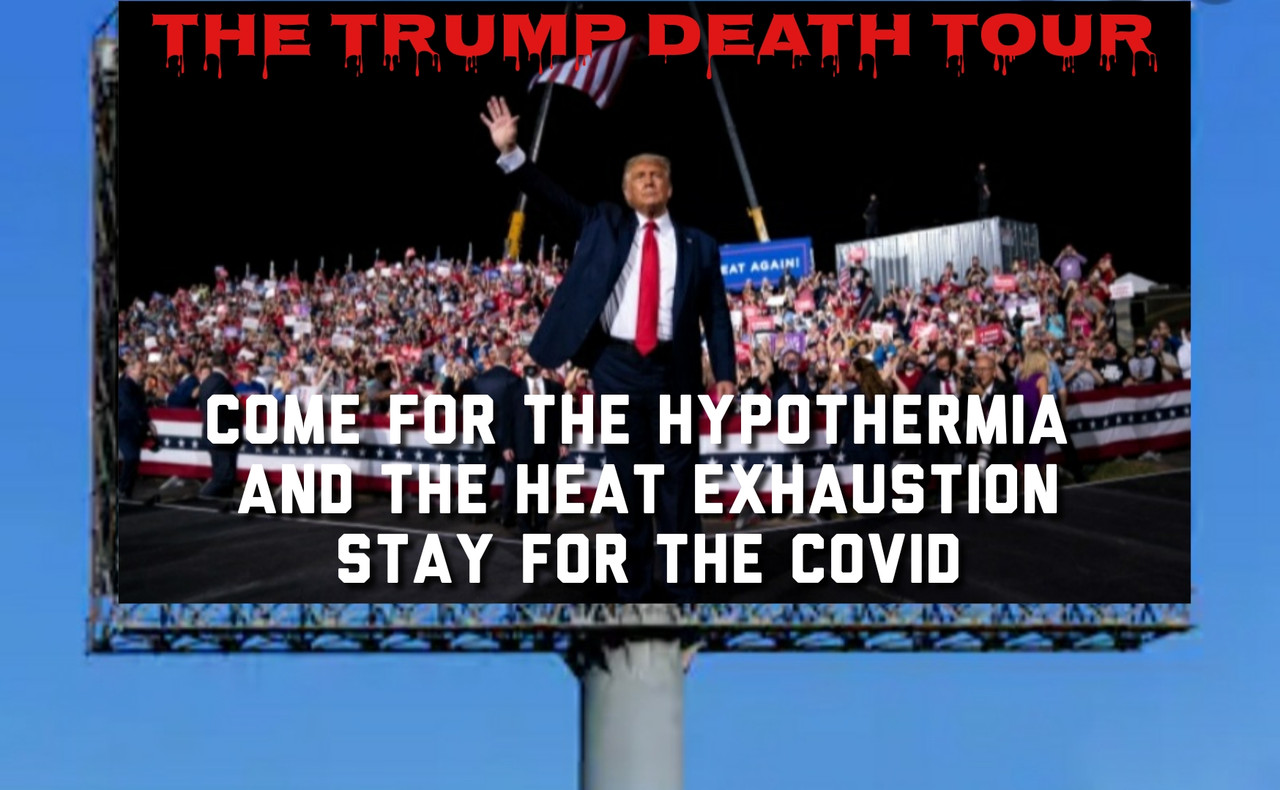
'Cause Typhoid Trump and Pence are doing such a bang up job.Jantje_Smit » 31 Oct 2020, 7:12 am » wrote: ↑We can only pray that the senile Biden clown get selected... he'll force everyone to wear a mask so we will be finally safe from the evil virus...
At spreading the virus.
31 Oct 2020 11:56 am
Gatewaypundit?Termin8tor » 31 Oct 2020, 10:36 am » wrote: ↑ I T-O-L-D Y-O-U.

But liberals didn't listen.Latest Polling: Trump Up 11 Points in Ohio — Five Points in Battleground Florida — Up in Arizona
By Jim Hoft
As they do EVERY election cycle the polls are starting to surge to the Republican candidate after months of ridiculous polling.
Author Ann Coulter wrote a book on how Democrats use far left polling to disenfranchised Republican voters.
They did it again this year.
https://www.thegatewaypundit.com/2020/1 ... a-arizona/
Is that the same Gatewaypundit that says that Joe Biden and his wife Jill are covering up for their son Hunter’s inappropriate relationship with an underage relative?
C'mon you fithy coward.
Do you believe that ****?
YES OR NO?
31 Oct 2020 12:08 pm
This is the Hunter Biden they say was totally unqualified to serve on the board of Burisma.
He seems a whole lot more qualified than Ivanka and Jared are to serve as advisors to the POTUS and work in the WH.EARLY CAREER
After law school, Biden accepted a position at bank holding company MBNA America, a major contributor to his father's political campaigns.
By 1998, Biden had risen to the rank of executive vice president and left to serve at the United States Department of Commerce until 2001, focusing on ecommerce policy.
Biden became a lobbyist in 2001, co-founding the firm of Oldaker, Biden & Belair.
According to Adam Entous of The New Yorker, Biden and his father established a relationship in which "Biden wouldn't ask Hunter about his lobbying clients, and Hunter wouldn't tell his father about them."
In 2006, Biden and his uncle James Biden attempted to buy hedge-fund group Paradigm, but the deal never materialized.
That same year, Hunter Biden was appointed to a five-year term on the board of directors of Amtrak by President George W. Bush.
Biden was the board's vice chairman from July 2006 until 2009; he resigned in February 2009, leaving both roles shortly after his father became vice president.
Biden said during his father's vice presidential campaign that it was time for his lobbying activities to end.
INVESTOR AND LOBBYIST
Biden is a capital investments professional with an interest in funding early-stage technology companies.
In September 2008, Biden launched a consultancy company named Seneca Global Advisors that offered to help companies expand into foreign markets.
Biden, Devon Archer, and Christopher Heinz founded the investment and advisory firm Rosemont Seneca Partners in 2009.
He also founded venture capital firm Eudora Global.
He held the position of counsel in the law firm Boies Schiller Flexner LLP in 2014.
Biden was on the board of directors of World Food Program USA, a 501(c)(3) charity based in Washington, D.C. that supports the work of the UN World Food Programme from 2011 to 2017; he served as board chairman from 2011 to 2015.
https://en.m.wikipedia.org/wiki/Hunter_Biden

31 Oct 2020 1:07 pm

You are a LIAR and a TRAITOr there WERE no such abuses of powe OR Felonies and you know it. I PROVED it and you ran away sobbing like the gutless coward you are. You just come back and tell the same lies over and over long AFTER they have been debunked what happened to that unmasking investigation the one you LIED about for months saying it would bring indictments fof Democrats the one that FODED wihtout even CLAIMING any wrongdoing and wont even release a report that would embarrass Barr just another thing you LIED about continuallyTermin8tor » 31 Oct 2020, 12:21 pm » wrote: ↑ .
True, you don't give a rat's *** about any of the felonies, abuses of power or impeachable acts your corrupt party commits.
As for Bobulinski he has his own credibility problems and his documentation has been looked at by serveral media sources and all off them including the Wall St Journal say they show NO wrongdoing by Joe Biden and he is DIRECTLy constradicted by the FACTS And other witnesses I showed you THAT evidence all day yesterday and predictably you ran away with your tail between your legs like the LIAR and GUTLESS COWARD you are
You are a LIAR and a TRAITOR and that is all you will ever be
31 Oct 2020 2:03 pm
You get that I dont read your petty childish posts dont you no dick ducky? Your childishness is BORING and you are STUPID consider that EVERY SINGLE PERSON on this site KNOWS how stupid you are. That you will ALWAYS BE that stupid. No one here respects you and no one EVER WILL but keep pounding out these CHILDISH PUNK posts that I dont read. Keep proving my point AGAIN AND AGAIN about how STUPID you are
31 Oct 2020 2:38 pm
You are a LIAR that is a proven FACT there is no eviidence of anything criminal by the Bidens you are a LIAR and aTRAITOR telling lies for Putin TRAITOR all you do is LIE
31 Oct 2020 3:12 pm
The only one who seems frantic and hysterical is you.Termin8tor » 31 Oct 2020, 12:16 pm » wrote: ↑Wow, psycho, you seem awfully frantic.Gatewaypundit?
Is that the same Gatewaypundit that says that Joe Biden and his wife Jill are covering up for their son Hunter’s inappropriate relationship with an underage relative?
C'mon you fithy coward.
Do you believe that ****?
YES OR NO?
You are posting your disinformation, propaganda, **** and lies as fast as you can.
I'm sitting here cleaning out my DVR by binge watching a whole season of Big Brother.
Where are those polls?Termin8tor » 31 Oct 2020, 12:16 pm » wrote: ↑I guess you've seen the polls shifting strongly for Trump.
Up your ***?
OIC, so we all have to adhere to only the subjects that you have written about and have interest in?Termin8tor » 31 Oct 2020, 12:16 pm » wrote: ↑ Why do you keep babbling about something that has nothing to do with anything I've written and have no interest in?
WOW!
We don't have a perverted view of our own sense of self importance, do we?
Face it Precious, this Hunter Biden **** isn't getting any traction with anyone except you brainwashed morons who dwell in the fever swamps.
Stop posting that **** in my thread.
I already voted for Biden, so you're wasting your time.
31 Oct 2020 3:20 pm
No.....I'm good with the polls and the manufactured evidence.Termin8tor » 31 Oct 2020, 2:36 pm » wrote: ↑Whew!YES OR NO??!!

Someone doesn't like the polls or the evidence coming out against the Biden Crime Family.
You're continuing to use that rag as a source means that you agree with them that Joe and Jill Biden are covering up for their son molesting an underage member of the family.
And you talk about me smearing people?
WTF has Jill Biden ever done for you to malign her like that?
31 Oct 2020 3:39 pm
Study links Trump rallies to more than 700 Covid deaths
The working paper, released late Friday, examined the impact of 18 rallies held between June 20 and Sept. 30.
President Donald Trump's campaign rallies between June and September may have caused some 30,000 coronavirus infections and more than 700 deaths, according to a new study by Stanford University economists.
The working paper, released late Friday, examined the impact of 18 rallies held between June 20 and Sept. 30 by comparing spread of the virus after each event to parts of the country that didn't host rallies.
The findings illustrate the risks of not heeding public health warnings to wear masks and avoid large gatherings to mitigate the risks of Covid-19, the authors — including B. Douglas Bernheim, the chair of Stanford's economics department — wrote.
“The communities in which Trump rallies took place paid a high price in terms of disease and death,” they wrote. Fifteen of the 18 events studied were held outdoors.
Trump has drawn criticism for continuing to hold events with large, tightly packed crowds in states that are experiencing outbreaks. Many in attendance, including Trump, have not worn masks.
Joe Biden's campaign seized on the findings Saturday as evidence Trump hasn't taken the ooronavirus pandemic seriously.
"He's even costing hundreds of lives and sparking thousands of cases with super spreader rallies that only serve his own ego,” Biden spokesperson Andrew Gates said.
Former President Barack Obama also cited the study on Saturday during an appearance with Biden in Michigan.
Trump campaign spokesperson Courtney Parella said attendees at the rallies have their temperature checked and are given masks that they are instructed to wear. Hand sanitizer is also provided.
https://www.politico.com/news/2020/10/3 ... ies-433760
The working paper, released late Friday, examined the impact of 18 rallies held between June 20 and Sept. 30.
President Donald Trump's campaign rallies between June and September may have caused some 30,000 coronavirus infections and more than 700 deaths, according to a new study by Stanford University economists.
The working paper, released late Friday, examined the impact of 18 rallies held between June 20 and Sept. 30 by comparing spread of the virus after each event to parts of the country that didn't host rallies.
The findings illustrate the risks of not heeding public health warnings to wear masks and avoid large gatherings to mitigate the risks of Covid-19, the authors — including B. Douglas Bernheim, the chair of Stanford's economics department — wrote.
“The communities in which Trump rallies took place paid a high price in terms of disease and death,” they wrote. Fifteen of the 18 events studied were held outdoors.
Trump has drawn criticism for continuing to hold events with large, tightly packed crowds in states that are experiencing outbreaks. Many in attendance, including Trump, have not worn masks.
Joe Biden's campaign seized on the findings Saturday as evidence Trump hasn't taken the ooronavirus pandemic seriously.
"He's even costing hundreds of lives and sparking thousands of cases with super spreader rallies that only serve his own ego,” Biden spokesperson Andrew Gates said.
Former President Barack Obama also cited the study on Saturday during an appearance with Biden in Michigan.
Trump campaign spokesperson Courtney Parella said attendees at the rallies have their temperature checked and are given masks that they are instructed to wear. Hand sanitizer is also provided.
https://www.politico.com/news/2020/10/3 ... ies-433760
31 Oct 2020 4:16 pm
31 Oct 2020 4:56 pm
Gutless COWARD and TRAITOR returns to tell the SAME LIES over and over LONG AFTER they were debunked and WHEN they were debunked did he ADDRESS the FACTS? Of COURSE NOT he ran away like the GUTLESS COWARD he is and came back later to REPEAT his petty stupid LIES. You are A TRAITORTermin8tor » 31 Oct 2020, 4:51 pm » wrote: ↑ .
Why are you looking in the wrong direction, psycho? Bobulinski's word is the evidence that Joe Biden was involved. He met with Biden twice to talk about the business deal Biden was part of.
https://www.politifact.com/article/2020 ... er/There’s reason to be skeptical about Bobulinski’s allegations, which credible news organizations have not corroborated. The Associated Press, for example, reported that it could not independently verify Bobulinki’s claims. PolitiFact has not been able to, either.
The Wall Street Journal reviewed his documents and found no evidence of wrongdoing by Joe Biden — or that he was active in his family’s foreign business endeavors, as Bobulinski claimed.
Bobulinski’s overarching claim is that Joe Biden was involved in, and may have profited from, his son and brother’s business dealings in China. He called Joe Biden’s claim that he never played a role in Hunter Biden’s foreign business endeavors "a blatant lie."
But the Journal reported that the text messages and emails Bobulinski shared from 2017 "don’t show either Hunter Biden or James Biden discussing a role for Joe Biden in the venture."
The venture in China "never received proposed funds from the Chinese company or completed any deals, according to people familiar with the matter," the outlet reported. "Corporate records reviewed by The Wall Street Journal show no role for Joe Biden."
The Journal also quoted Gilliar, the British nat
ional involved in SinoHawk, as saying he was "unaware of any involvement at any time of the former vice president." Gilliar added that "the activity in question never delivered any project revenue."
The New York Times reached the same conclusion about Bublinski’s records. Financial disclosures and tax records for Joe Biden show no indication of any income related to the venture at hand, as the Times and Vox reported.
Bobulinski claimed he met with the elder Biden twice, including once in May 2017 at Hunter and James Biden’s request. Bobulinski told Carlson that it was "crystal clear" that Hunter Biden had told his father about the venture, but he also said the group "didn’t go into too much detail on business" during the meeting. After a speech Joe Biden gave the next day, Bobulinski said the former vice president asked for his thoughts on the speech and then told him to "keep an eye on his son and his brother."
Joe Biden was not in office at the time, nor had he launched his campaign for president.
ADDRESS the FACTS or STFU GUTLESS COWARD
31 Oct 2020 5:26 pm
31 Oct 2020 5:32 pm
Well since you believe everything you read on Gatewaypundit, then you must also believe that Joe Biden and his wife Jill are covering up the fact that their son molested an underage relative.Termin8tor » 31 Oct 2020, 4:48 pm » wrote: ↑What, are you claiming that Gateway fabricated McDaniels' tweets, psycho?Misty » 31 Oct 2020, 3:20 pm » wrote: ↑ No.....I'm good with the polls and the manufactured evidence.
Those are real numbers.
You refuse to deny it, and you say Gatewaypundit is a reliable source, so I guess you believe it.
Good to know.
31 Oct 2020 5:35 pm
That's right you haven't written one single word in her defense, which makes you complicit with the Gatewaypundit smear of her.Termin8tor » 31 Oct 2020, 4:51 pm » wrote: ↑Weird, but I haven't written one single word about poor Jill, whose husband might end up in federal prison.Misty » 31 Oct 2020, 3:20 pm » wrote: ↑ You're continuing to use that rag as a source means that you agree with them that Joe and Jill Biden are covering up for their son molesting an underage member of the family.
And you talk about me smearing people?
WTF has Jill Biden ever done for you to malign her like that?
31 Oct 2020 5:41 pm
Prove they are lying you **** psycho.Termin8tor » 31 Oct 2020, 4:49 pm » wrote: ↑Heck, if they're going to lie, might as well make 14 gazillion deaths!
Do you even begin to understand how ridiculous you sound?
You just reflexively call everyone who says anything that negatively reflects on your Dear Leader a liar, without any proof, yet you believe every word out of that pathological liar's mouth.
Oh, except for the occasional fib that he tells.
31 Oct 2020 8:57 pm
31 Oct 2020 10:52 pm
Security info request from Trump campaign perturbs Cumberland County, PA officials ahead of election
Cumberland County officials received an email this week from the Trump campaign requesting highly specific details about the county’s ballot security.
The email, obtained by The Sentinel, went so far as to ask for the address and room numbers of ballot storage locations, and requested that the information be sent to the Gmail account of a Florida-based Trump operative.
County officials said they have not responded to the request and do not intend to, according to the county commissioners.
The Trump campaign described the request as “standard election transparency details,” but local officials find the implication — that the President’s campaign staff is harvesting election security plans through what appears to be a personal web-based email account — to be extremely concerning.
“It’s almost kind of chilling the sort of data they wanted us to provide,” Cumberland County Commissioner Gary Eichelberger said.
“This is basically the whole security plan. We’ve never received a request of this detail and I find it troubling that one of the interested parties [in the election outcome] feels they have a right to information that obviously could jeopardize the security of the ballots.”
The message was sent Tuesday, according to emails reviewed by The Sentinel, from Leslie O’Shaughnessy, who said she was writing “on behalf of Donald J. Trump for President.”
The email contained an attached, bullet-pointed list of the details requested, which O’Shaughnessy described as being pursuant to “your office’s compliance with existing statutes and law.”
“Please respond to these questions no later than 5:00 pm EST, tomorrow, Wednesday, October 28, 2020,” the email stated, asking for the response to be sent to a Gmail account bearing O’Shaughnessy’s name, and also including a phone number.
That number is tied to an Orlando-area virtual learning center, as well as a personal Facebook page for O’Shaughnessy where she identifies herself in a publicly visible post as having “served as an appointee in the Trump Administration in Washington DC.”
A person who identified themselves as “Leslie” answered the phone number but declined to discuss their role in the email with The Sentinel.
The Trump campaign’s communications office confirmed to The Sentinel that O’Shaughnessy is a volunteer with the campaign, and offered an explanatory statement from Deputy National Press Secretary Thea McDonald.
“As part of the Trump campaign’s efforts to ensure a free and fair election, we have asked county clerks for information so that we can gain a detailed understanding of voting processes — and the similarities and differences that may exist in different jurisdictions,” McDonald wrote.
“Given that more than 500,000 mail ballots were tossed out in this year’s primaries, we must look into these critical issues ahead of November,” she said, linking to a Washington Post feature on the volume of vote-by-mail ballots that were disqualified in the spring due to late arrivals, missing signatures, illegible marks, and other reasons.
But the details O’Shaughnessy asked for in her email do not concern ballot verification; rather, they are specific physical security details for ballots and voting machines.
These include information on “the location(s) that ballots are immediately sent to when polls close (including address and room number)” as well as “the individuals who transport the ballots to the location(s).”
The campaign is also asking for “the time(s) when are ballots are transported to canvass site,” information on any security provided, and “the best point of contact for each storage location(s) of the ballots.”
Similar physical security details are asked for voting machines, as well as “If there will be any info still on the voting machines once they are stored” and “the time when any residual information is wiped.”
“The information we’ve asked for includes standard election transparency details, and election officials should have the answers on hand. When did transparency become a bad thing?” McDonald said in her emailed statement.
Cumberland County officials said they don’t see it that way, particularly given that Trump has spent months baselessly suggesting that the election will be compromised, particularly because of mail-in ballots. Trump has also suggested he will seek to use the court system to have ballots thrown out during the counting process in the days following Nov. 3.
The campaign has been particularly aggressive in Pennsylvania, filming ballot drop-off points and attempting to have poll watchers confront voters who were delivering or filling out a ballot at Philadelphia voting centers, according to reporting from the New York Times and other outlets.
“Taken in total with some of the other rhetoric that’s out there, this just magnifies our concerns,” Eichelberger said.
His colleagues, county commissioners Jean Foschi and Vince DiFilippo, also confirmed the existence of the email and echoed similar sentiments.
Foschi said it would be “highly irresponsible” for the county to surrender such information given Trump’s threats.
While the matter isn’t the only security concern that has made the county reluctant to do pre-canvassing of ballots on Election Day, “you could add it to the list,” DiFilippo said.
The commissioners have borne a significant amount of criticism over the past week since the county announced that it expected to cancel its previously planned pre-canvassing on Election Day.
Pennsylvania law allows counties to get a head-start on counting absentee and mail-in ballots by pre-canvassing starting at 7 a.m. on Election Day, a process that can involve opening, sorting, and counting ballots.
Full canvassing — to include the actual recording of the votes in the county’s election database — cannot begin until the close of polls at 8 p.m. on Election Day, but pre-canvassing gives counties a head-start that can save them a few hours or possibly days in their total vote-counting timeline.
Cumberland County officials said their decision not to pre-canvass was due to the expected volume of pre-canvass observers from candidates and political parties, and the difficulty of managing those individuals while election staff is also trying to do the pre-canvass work and provide assistance to precinct-level poll workers.
Critics said the county should have done more to secure a larger venue and additional staff to do a pre-canvassing.
Many concerned callers at Thursday’s county elections board meeting said the county was creating a political perception problem if the county’s full results take longer to arrive than those of other jurisdictions due to a lack of pre-canvassing.
That in turn could give Trump more opportunities to cry foul as votes for Democrats, more of whom have requested mail-in ballots than Republicans, are added to the vote totals.
But during Thursday’s meeting, the commissioners expressed concern that the marginal advantage of pre-canvassing was not worth the security risk of trying to do too many things at once.
At one point during the meeting, Eichelberger referenced concerns over dubious requests for security information that could be used to discredit the election — a reference to the Trump campaign’s efforts, although it was not explicitly acknowledged during the public meeting.
Legal counsel told county officials that the only means for the Trump campaign — as a private entity operating out of a Gmail account — to force the surrender of information would be through a Pennsylvania Right-to-Know request.
The Sentinel has inquired with the Pennsylvania Department of State as to whether any provisions of the state’s election code would require security information to be surrendered to a qualified candidate’s campaign, and whether other counties have received such requests.
Cumberland County officials said their understanding was that other counties in the state had gotten the Trump campaign email.
Earlier this month, the Associated Press reported on the Trump campaign’s strategy of pressuring local elections officials after the campaign sent emails to county offices in North Carolina instructing them to not follow a court ruling on vote processing seen as adverse to Trump.
Erik Arneson, executive director of the state Office of Open Records, which adjudicates right-to-know requests, said his office has never dealt with such a request seeking the election security information the Trump campaign is asking for.
“I’m not prejudging any case we might get or prejudging any facts,” Arneson said, but he offered some analogous scenarios where specific security information has been sought.
Right-to-know requests for the location and security measures where police store confiscated weapons, for instance, or requests for information on when and how government agencies transport cash revenue, have been shot down.
“Those are things that we have allowed agencies to withhold, because they do go to the issue of safety and security around critical infrastructure,” Arneson said.
“Those kinds of things we’ve held are exempt under the Right-to-Know Law.”
Pennsylvania, and specifically Cumberland County, have played an outsize role in the 2020 campaign.
Trump and his opponent, Democratic former Vice President Joe Biden, stand limited statistical chance of winning office without carrying the state.
Cumberland County has 187,404 registered voters for the 2020 election, according to the most recent state data. Trump received nearly 56% of the vote in the county in 2016, winning by almost 18 points over Hillary Clinton.
But in 2018, Cumberland County voters supported the top Democrat on the ballot, Gov. Tom Wolf, who pulled in just over half the vote in the county to beat GOP candidate Scott Wagner by three points.
https://cumberlink.com/news/local/govt- ... ssion=true
Cumberland County officials received an email this week from the Trump campaign requesting highly specific details about the county’s ballot security.
The email, obtained by The Sentinel, went so far as to ask for the address and room numbers of ballot storage locations, and requested that the information be sent to the Gmail account of a Florida-based Trump operative.
County officials said they have not responded to the request and do not intend to, according to the county commissioners.
The Trump campaign described the request as “standard election transparency details,” but local officials find the implication — that the President’s campaign staff is harvesting election security plans through what appears to be a personal web-based email account — to be extremely concerning.
“It’s almost kind of chilling the sort of data they wanted us to provide,” Cumberland County Commissioner Gary Eichelberger said.
“This is basically the whole security plan. We’ve never received a request of this detail and I find it troubling that one of the interested parties [in the election outcome] feels they have a right to information that obviously could jeopardize the security of the ballots.”
The message was sent Tuesday, according to emails reviewed by The Sentinel, from Leslie O’Shaughnessy, who said she was writing “on behalf of Donald J. Trump for President.”
The email contained an attached, bullet-pointed list of the details requested, which O’Shaughnessy described as being pursuant to “your office’s compliance with existing statutes and law.”
“Please respond to these questions no later than 5:00 pm EST, tomorrow, Wednesday, October 28, 2020,” the email stated, asking for the response to be sent to a Gmail account bearing O’Shaughnessy’s name, and also including a phone number.
That number is tied to an Orlando-area virtual learning center, as well as a personal Facebook page for O’Shaughnessy where she identifies herself in a publicly visible post as having “served as an appointee in the Trump Administration in Washington DC.”
A person who identified themselves as “Leslie” answered the phone number but declined to discuss their role in the email with The Sentinel.
The Trump campaign’s communications office confirmed to The Sentinel that O’Shaughnessy is a volunteer with the campaign, and offered an explanatory statement from Deputy National Press Secretary Thea McDonald.
“As part of the Trump campaign’s efforts to ensure a free and fair election, we have asked county clerks for information so that we can gain a detailed understanding of voting processes — and the similarities and differences that may exist in different jurisdictions,” McDonald wrote.
“Given that more than 500,000 mail ballots were tossed out in this year’s primaries, we must look into these critical issues ahead of November,” she said, linking to a Washington Post feature on the volume of vote-by-mail ballots that were disqualified in the spring due to late arrivals, missing signatures, illegible marks, and other reasons.
But the details O’Shaughnessy asked for in her email do not concern ballot verification; rather, they are specific physical security details for ballots and voting machines.
These include information on “the location(s) that ballots are immediately sent to when polls close (including address and room number)” as well as “the individuals who transport the ballots to the location(s).”
The campaign is also asking for “the time(s) when are ballots are transported to canvass site,” information on any security provided, and “the best point of contact for each storage location(s) of the ballots.”
Similar physical security details are asked for voting machines, as well as “If there will be any info still on the voting machines once they are stored” and “the time when any residual information is wiped.”
“The information we’ve asked for includes standard election transparency details, and election officials should have the answers on hand. When did transparency become a bad thing?” McDonald said in her emailed statement.
Cumberland County officials said they don’t see it that way, particularly given that Trump has spent months baselessly suggesting that the election will be compromised, particularly because of mail-in ballots. Trump has also suggested he will seek to use the court system to have ballots thrown out during the counting process in the days following Nov. 3.
The campaign has been particularly aggressive in Pennsylvania, filming ballot drop-off points and attempting to have poll watchers confront voters who were delivering or filling out a ballot at Philadelphia voting centers, according to reporting from the New York Times and other outlets.
“Taken in total with some of the other rhetoric that’s out there, this just magnifies our concerns,” Eichelberger said.
His colleagues, county commissioners Jean Foschi and Vince DiFilippo, also confirmed the existence of the email and echoed similar sentiments.
Foschi said it would be “highly irresponsible” for the county to surrender such information given Trump’s threats.
While the matter isn’t the only security concern that has made the county reluctant to do pre-canvassing of ballots on Election Day, “you could add it to the list,” DiFilippo said.
The commissioners have borne a significant amount of criticism over the past week since the county announced that it expected to cancel its previously planned pre-canvassing on Election Day.
Pennsylvania law allows counties to get a head-start on counting absentee and mail-in ballots by pre-canvassing starting at 7 a.m. on Election Day, a process that can involve opening, sorting, and counting ballots.
Full canvassing — to include the actual recording of the votes in the county’s election database — cannot begin until the close of polls at 8 p.m. on Election Day, but pre-canvassing gives counties a head-start that can save them a few hours or possibly days in their total vote-counting timeline.
Cumberland County officials said their decision not to pre-canvass was due to the expected volume of pre-canvass observers from candidates and political parties, and the difficulty of managing those individuals while election staff is also trying to do the pre-canvass work and provide assistance to precinct-level poll workers.
Critics said the county should have done more to secure a larger venue and additional staff to do a pre-canvassing.
Many concerned callers at Thursday’s county elections board meeting said the county was creating a political perception problem if the county’s full results take longer to arrive than those of other jurisdictions due to a lack of pre-canvassing.
That in turn could give Trump more opportunities to cry foul as votes for Democrats, more of whom have requested mail-in ballots than Republicans, are added to the vote totals.
But during Thursday’s meeting, the commissioners expressed concern that the marginal advantage of pre-canvassing was not worth the security risk of trying to do too many things at once.
At one point during the meeting, Eichelberger referenced concerns over dubious requests for security information that could be used to discredit the election — a reference to the Trump campaign’s efforts, although it was not explicitly acknowledged during the public meeting.
Legal counsel told county officials that the only means for the Trump campaign — as a private entity operating out of a Gmail account — to force the surrender of information would be through a Pennsylvania Right-to-Know request.
The Sentinel has inquired with the Pennsylvania Department of State as to whether any provisions of the state’s election code would require security information to be surrendered to a qualified candidate’s campaign, and whether other counties have received such requests.
Cumberland County officials said their understanding was that other counties in the state had gotten the Trump campaign email.
Earlier this month, the Associated Press reported on the Trump campaign’s strategy of pressuring local elections officials after the campaign sent emails to county offices in North Carolina instructing them to not follow a court ruling on vote processing seen as adverse to Trump.
Erik Arneson, executive director of the state Office of Open Records, which adjudicates right-to-know requests, said his office has never dealt with such a request seeking the election security information the Trump campaign is asking for.
“I’m not prejudging any case we might get or prejudging any facts,” Arneson said, but he offered some analogous scenarios where specific security information has been sought.
Right-to-know requests for the location and security measures where police store confiscated weapons, for instance, or requests for information on when and how government agencies transport cash revenue, have been shot down.
“Those are things that we have allowed agencies to withhold, because they do go to the issue of safety and security around critical infrastructure,” Arneson said.
“Those kinds of things we’ve held are exempt under the Right-to-Know Law.”
Pennsylvania, and specifically Cumberland County, have played an outsize role in the 2020 campaign.
Trump and his opponent, Democratic former Vice President Joe Biden, stand limited statistical chance of winning office without carrying the state.
Cumberland County has 187,404 registered voters for the 2020 election, according to the most recent state data. Trump received nearly 56% of the vote in the county in 2016, winning by almost 18 points over Hillary Clinton.
But in 2018, Cumberland County voters supported the top Democrat on the ballot, Gov. Tom Wolf, who pulled in just over half the vote in the county to beat GOP candidate Scott Wagner by three points.
https://cumberlink.com/news/local/govt- ... ssion=true

31 Oct 2020 11:02 pm
Who is online
In total there are 10719 users online :: 0 registered, 16 bots, and 10703 guests
Registered users:
Bots: NING, Pinterest, Adsbot, MicroMessenger, DuckDuckBot, CriteoBot, ADmantX, Baiduspider, Firefox/7.0, facebookexternalhit, Applebot, proximic, Mediapartners-Google, curl/7, Googlebot, bingbot