Liberal Forum
Archive
‹
Political Chat Rooms
‹
No Holds Barred Political Forum
‹
BREAKING: Judge rules voting machines unconstitutional in GEORGIA!!
BREAKING: Judge rules voting machines unconstitutional in GEORGIA!!

By Majik
23 Nov 2023 7:57 am in No Holds Barred Political Forum
23 Nov 2023 7:57 am

“Now comes news from a district court in Georgia that we’re not ‘conspiracy theorists’ if we question the integrity of our elections, including the security of voting machines.” “Remember, so many of us were censored for even discussing this subject, which tells you all you need to know about whether we should be asking questions.” “Relentless” Episode 010. LISTEN: – Kyle Becker – see clip belowHere’s a Georgia, election supervisor laying out the process how Dominion voting machines ‘adjudicated’ the 2020 Insurrection at 68.05% error rate.“Can you scan a ballot more than once and COUNT THEM?”“I just done it” pic.twitter.com/fYkhsyLdHP—RealRobert
- BREAKING: A federal judge, appointed by Obama, just ruled against voting machines in Georgia ‘The machines’s cybersecurity flaws violate the constitutional rights of voters’ – Jack Poso
- BREAKING: Election deniers & conspiracy theorists, US District Judge Totenberg, Obama appointee rules in Georgia against [Dominion] voting machines, can be hacked, manipulated via criminal activity. “does not suggest that the plaintiffs are conspiracy theorists of any variety.” Clip at Twitter
23 Nov 2023 8:04 am
WAUSAU, WI (WSAU) – A U.S. federal judge ruled in favor of a landmark lawsuit in the state of Georgia that alleges that voting machines can be hacked or manipulated via cyberattacks and other criminal activity.2 days ago
https://wsau.com › 2023/11/21 › u-...
U.S Federal Judge Rules Against Voting Machines In Georgia; Wisconsin Could See Similar Lawsuit - WSAU
https://wsau.com › 2023/11/21 › u-...
U.S Federal Judge Rules Against Voting Machines In Georgia; Wisconsin Could See Similar Lawsuit - WSAU

23 Nov 2023 8:38 am
And the progressive leftists will say...Majik » 23 Nov 2023, 8:57 am » wrote: ↑ “Now comes news from a district court in Georgia that we’re not ‘conspiracy theorists’ if we question the integrity of our elections, including the security of voting machines.” “Remember, so many of us were censored for even discussing this subject, which tells you all you need to know about whether we should be asking questions.” “Relentless” Episode 010. LISTEN: – Kyle Becker – see clip belowhttps://choiceclips.whatfinger.com/2023 ... qus_thread
- BREAKING: A federal judge, appointed by Obama, just ruled against voting machines in Georgia ‘The machines’s cybersecurity flaws violate the constitutional rights of voters’ – Jack Poso
- BREAKING: Election deniers & conspiracy theorists, US District Judge Totenberg, Obama appointee rules in Georgia against [Dominion] voting machines, can be hacked, manipulated via criminal activity. “does not suggest that the plaintiffs are conspiracy theorists of any variety.” Clip at Twitter

The powers not delegated to the United States by the Constitution, nor prohibited by it to the States, are reserved to the States respectively, or to the people

23 Nov 2023 8:46 am
exactly...like everything in gubment, nothing will come of it...and the day before voting day, 2024, someone will "bring it up"...they'll smile and "promise" it's either all good or it'll be addressed AFTER the election...
 JuCo 5 percenter...72
“Show me the man and I’ll find you the crime” ~ LAVRENTIY BERIA
"Try to get past your passionate ignorance and learn to accept what actually happened." ~ brown's unheeded words of wisdom
JuCo 5 percenter...72
“Show me the man and I’ll find you the crime” ~ LAVRENTIY BERIA
"Try to get past your passionate ignorance and learn to accept what actually happened." ~ brown's unheeded words of wisdom  If gender is not sex, why should a gender claim change what sex you shower with?
"Libruls are often fascists on vacation..."
If gender is not sex, why should a gender claim change what sex you shower with?
"Libruls are often fascists on vacation..."
23 Nov 2023 8:51 am
"The most fair and secure election in the history of the Country".ROG62 » 23 Nov 2023, 9:46 am » wrote: ↑ exactly...like everything in gubment, nothing will come of it...and the day before voting day, 2024, someone will "bring it up"...they'll smile and "promise" it's either all good or it'll be addressed AFTER the election...
Because the people in charge of the election said so.
The powers not delegated to the United States by the Constitution, nor prohibited by it to the States, are reserved to the States respectively, or to the people
23 Nov 2023 8:56 am
+1000RedheadedStranger » 23 Nov 2023, 9:51 am » wrote: ↑ "The most fair and secure election in the history of the Country".
Because the people in charge of the election said so.
JuCo 5 percenter...72
“Show me the man and I’ll find you the crime” ~ LAVRENTIY BERIA
"Try to get past your passionate ignorance and learn to accept what actually happened." ~ brown's unheeded words of wisdom
If gender is not sex, why should a gender claim change what sex you shower with?
"Libruls are often fascists on vacation..." 
23 Nov 2023 10:19 am

It's pretty close to certain that the 2020 election was rigged. Sadly, nobody will be punished for it. 2024 will be rigged also.
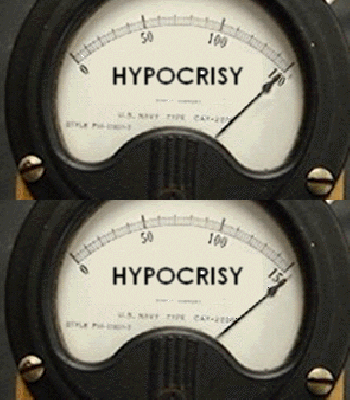
Blackvegatble's hypcorisy summed up in one post:
[/size]
Blackvegetable » 7 minutes ago » wrote: ↑7 minutes ago
Very simple questions...
From which you are running...
Blackvegetable » 7 minutes ago » wrote: ↑7 minutes ago
Very simple questions...
From which you are running...
23 Nov 2023 10:20 am
And given how much @Squatchman hates democracy and loves tyranny, his response to this will be "Ha ha."
Blackvegatble's hypcorisy summed up in one post:
[/size]
Blackvegetable » 7 minutes ago » wrote: ↑7 minutes ago
Very simple questions...
From which you are running...
Blackvegetable » 7 minutes ago » wrote: ↑7 minutes ago
Very simple questions...
From which you are running...
23 Nov 2023 10:48 am
Last Friday U.S. District Court Judge Amy Totenberg issued a scathing ruling on Secretary of State Brad Raffensperger’s motion to dismiss the long-running Curling v. Raffensperger lawsuit. The plaintiffs asked the federal judge to rule that Dominion Ballot Marking Devices (BMDs) could no longer be used in Georgia because they are unsecure and vulnerable to hacking. Taking that into consideration, the judge ruled against Raffensperger and ordered a trial to begin on January 9.
It’s significant that Totenberg wrote that no election security expert has endorsed Georgia’s touchscreen system, which expert witness Dr. Alex Halderman found to be at extreme risk for undetectable attack in a 2021 report. His findings were confirmed by none other than the U.S. Department of Homeland Security, yet the Secretary of State’s office declares the system is secure and cites cost considerations for not initiating changes until after the 2024 elections.
Lt. Gov. Burt Jones and other state lawmakers have also expressed deep concern over the need for election security upgrades, and a consistent Raffensperger critic has been The Coalition for Good Governance.
“The Court noted the misleading and conflicting claims by Secretary Raffensperger about the Coffee (voting system) breaches and his delayed and ineffective response,” says Coalition Executive Director Marilyn Marks. “The order notes how the breaches have grave implications for the security of future elections. Secretary Raffensperger and the State Election Board have continued to bury their heads in the sand, not wanting to second guess Secretary Raffensperger’s 2019 purchase of the highly flawed system that experts have concluded is less secure than the old Diebold paperless system it replaced.”
“The gravely serious issues are being exacerbated with the continuing spread of the stolen software to unauthorized actors with unknown intent,” Marks continues. “No amount of software patches or ‘audits’ can mitigate the dangers of the flawed touchscreen system design. Only hand marked ballots counted by scanners can ensure verifiable election outcomes. The currently debated software update 5.17 is a necessary action, but falls far short of delivering a system that can pass constitutional muster to protect the voters’ rights to cast accountable votes.”
Marks notes a recent BMD touchscreen voting problem in Northampton, Pennsylvania, is the latest example of why such BMDs are unsafe by design. Flawed programming caused two judge retention questions to print the paper ballot with the wrong Yes or No vote, although the barcode to be tabulated was reportedly accurate, creating a paper ballot which did not reflect the voters’ choice.
The bottom line: Plaintiffs in the lawsuit hope to win at the trial by demonstrating why touchscreen BMDs cannot be used safely. The judge also emphasized that a mutually agreeable negotiated resolution with the Secretary of State’s office would be in the public interest.
By the way, as the plaintiffs note, balloting security could be implemented early next year, since Georgia has long-standing fail-safe voting system statutes that permit scanner-tabulated, hand marked ballots for just such problems with the touchscreen component of the system.
https://jamesmagazinega.com/2023/11/13/ ... stem-case/
It’s significant that Totenberg wrote that no election security expert has endorsed Georgia’s touchscreen system, which expert witness Dr. Alex Halderman found to be at extreme risk for undetectable attack in a 2021 report. His findings were confirmed by none other than the U.S. Department of Homeland Security, yet the Secretary of State’s office declares the system is secure and cites cost considerations for not initiating changes until after the 2024 elections.
Lt. Gov. Burt Jones and other state lawmakers have also expressed deep concern over the need for election security upgrades, and a consistent Raffensperger critic has been The Coalition for Good Governance.
“The Court noted the misleading and conflicting claims by Secretary Raffensperger about the Coffee (voting system) breaches and his delayed and ineffective response,” says Coalition Executive Director Marilyn Marks. “The order notes how the breaches have grave implications for the security of future elections. Secretary Raffensperger and the State Election Board have continued to bury their heads in the sand, not wanting to second guess Secretary Raffensperger’s 2019 purchase of the highly flawed system that experts have concluded is less secure than the old Diebold paperless system it replaced.”
“The gravely serious issues are being exacerbated with the continuing spread of the stolen software to unauthorized actors with unknown intent,” Marks continues. “No amount of software patches or ‘audits’ can mitigate the dangers of the flawed touchscreen system design. Only hand marked ballots counted by scanners can ensure verifiable election outcomes. The currently debated software update 5.17 is a necessary action, but falls far short of delivering a system that can pass constitutional muster to protect the voters’ rights to cast accountable votes.”
Marks notes a recent BMD touchscreen voting problem in Northampton, Pennsylvania, is the latest example of why such BMDs are unsafe by design. Flawed programming caused two judge retention questions to print the paper ballot with the wrong Yes or No vote, although the barcode to be tabulated was reportedly accurate, creating a paper ballot which did not reflect the voters’ choice.
The bottom line: Plaintiffs in the lawsuit hope to win at the trial by demonstrating why touchscreen BMDs cannot be used safely. The judge also emphasized that a mutually agreeable negotiated resolution with the Secretary of State’s office would be in the public interest.
By the way, as the plaintiffs note, balloting security could be implemented early next year, since Georgia has long-standing fail-safe voting system statutes that permit scanner-tabulated, hand marked ballots for just such problems with the touchscreen component of the system.
https://jamesmagazinega.com/2023/11/13/ ... stem-case/
23 Nov 2023 10:56 am
Dominion is sweating bullets .....Vegas » 23 Nov 2023, 11:19 am » wrote: ↑ It's pretty close to certain that the 2020 election was rigged. Sadly, nobody will be punished for it. 2024 will be rigged also.
look at their website .....which was updated Nov. 23.
https://www.dominionvoting.com/setting- ... -straight/
23 Nov 2023 11:09 am
23 Nov 2023 11:17 am
How did Dominion get certification from US EAC when they supposedly tested their machines ? Back in 2019?

23 Nov 2023 11:31 am
23 Nov 2023 11:32 am
Majik » 23 Nov 2023, 11:56 am » wrote: ↑ Dominion is sweating bullets .....
look at their website .....which was updated Nov. 23.
https://www.dominionvoting.com/setting- ... -straight/
Of course they are going to publish no wrong doings about their machines. It's their machines. Lol
Blackvegatble's hypcorisy summed up in one post:
[/size]
Blackvegetable » 7 minutes ago » wrote: ↑7 minutes ago
Very simple questions...
From which you are running...
Blackvegetable » 7 minutes ago » wrote: ↑7 minutes ago
Very simple questions...
From which you are running...

23 Nov 2023 11:54 am

THIS.Vegas » 23 Nov 2023, 11:19 am » wrote: ↑ It's pretty close to certain that the 2020 election was rigged. Sadly, nobody will be punished for it. 2024 will be rigged also.

23 Nov 2023 11:55 am
.ROG62 » 23 Nov 2023, 9:46 am » wrote: ↑ exactly...like everything in gubment, nothing will come of it...and the day before voting day, 2024, someone will "bring it up"...they'll smile and "promise" it's either all good or it'll be addressed AFTER the election...
Like I tell all the ultraliberal fruitcakes that accuse me of being a Trump wiene hugger...all I like about him is he push ultraliberals buttons.
.
Why didn't he get all the stuff he promised last time done; at least get it in the works. Sleepy Joe is in the same boat.
ultraliberals are not happy unless they are obsessing about something.
.
.
.

.
.
.

23 Nov 2023 1:25 pm
I am a little confused. This article is about touchscreen voting machines. Seems to me the big issue for MAGA morons for 2020 wasn't fraud with in-person touchscreen voting, but with mail-in ballots. Who knows, if touchscreen voting machines are the problem, maybe they would account for the clown's improbable 2016 victory over Hillary? One thing I do know is that the guy the clown himself installed to ensure that the 2020 election was fair and square, Chris Krebs, said unequivocally "the 2020 election was the most secure in US history". He went on to say, “This point cannot be emphasized enough: The secretaries of state in Georgia, Michigan, Arizona, Nevada and Pennsylvania, as well officials in Wisconsin, all worked overtime to ensure there was a paper trail that could be audited or recounted by hand, independent of any allegedly hacked software or hardware,”
MAGA moron whiners are SUCH poor losers!
MAGA moron whiners are SUCH poor losers!
23 Nov 2023 1:33 pm
They all are...at least the economy was smoking under Trump...MackTheFinger » 23 Nov 2023, 12:55 pm » wrote: ↑ .
Like I tell all the ultraliberal fruitcakes that accuse me of being a Trump wiene hugger...all I like about him is he push ultraliberals buttons.
.
Why didn't he get all the stuff he promised last time done; at least get it in the works. Sleepy Joe is in the same boat.
JuCo 5 percenter...72
“Show me the man and I’ll find you the crime” ~ LAVRENTIY BERIA
"Try to get past your passionate ignorance and learn to accept what actually happened." ~ brown's unheeded words of wisdom
If gender is not sex, why should a gender claim change what sex you shower with?
"Libruls are often fascists on vacation..."
23 Nov 2023 1:55 pm
.ROG62 » 23 Nov 2023, 2:33 pm » wrote: ↑ They all are...at least the economy was smoking under Trump...
Yeah and he pissed off a bunch ultraliberals.
.
I read this ultraliberal article about him and it said with glee...he was the only President that was ever impeached 2 times. I said to myself...'these people are headcases.' It is meaningless and was a waste of taxpayers $$$ because everyone in the country knew the Senate would have never removed him from power.
.
Just like Bubba...the Senate all knew he lied under oath to Congress (since he admitted it) and all the DEMs in the Seate voted not to remove him.
ultraliberals are not happy unless they are obsessing about something.
.
.
.
.
.
.
23 Nov 2023 2:04 pm
Nothing ever changes in gubment, not even the faces...MackTheFinger » 23 Nov 2023, 2:55 pm » wrote: ↑ .
Yeah and he pissed off a bunch ultraliberals.
.
I read this ultraliberal article about him and it said with glee...he was the only President that was ever impeached 2 times. I said to myself...'these people are headcases.' It is meaningless and was a waste of taxpayers $$$ because everyone in the country knew the Senate would have never removed him from power.
.
Just like Bubba...the Senate all knew he lied under oath to Congress (since he admitted it) and all the DEMs in the Seate voted not to remove him.
JuCo 5 percenter...72
“Show me the man and I’ll find you the crime” ~ LAVRENTIY BERIA
"Try to get past your passionate ignorance and learn to accept what actually happened." ~ brown's unheeded words of wisdom
If gender is not sex, why should a gender claim change what sex you shower with?
"Libruls are often fascists on vacation..." Who is online
In total there are 2834 users online :: 9 registered, 13 bots, and 2812 guests
Registered users: Johnny You, Blackvegetable, Zeets2, ROG62, Beekeeper, Cannonpointer, nefarious101, Huey, Fuelman
Bots: MicroMessenger, NING, ADmantX, Disco, CriteoBot, Googlebot, proximic, YandexBot, facebookexternalhit, curl/7, Applebot, Mediapartners-Google, bingbot