Liberal Forum
Archive
‹
Political Chat Rooms
‹
No Holds Barred Political Forum
‹
The green scam: How electric vehicles harm the environment that they’re supposed to save
The green scam: How electric vehicles harm the environment that they’re supposed to save

By Majik
24 Nov 2023 5:51 pm in No Holds Barred Political Forum
4 posts • Page 1 of 1
24 Nov 2023 5:51 pm

In 2032, India will need a billion tonnes of coal, partly to charge EVs in urban areas via power generated by thermal plantsFive Indian cities, including the capital, New Delhi, consistently rank in the world's top ten worst air-polluted cities. Vehicular emissions are significant contributors; Delhi alone has around four million cars – no wonder the government of India is promoting electric vehicles (EVs) on a large scale. While India's target is a 30% market share of EVs by 2030, the share is currently only 1.1%. Moreover, concerns exist about whether EVs are a green option if pollution is transferred from the cities to the countryside.Around 27.4 million EVs were running on Indian roads as of July 2023, according to the 'Vahan4' portal of the Ministry of Road, Transport, and Highways. To achieve its goal of net zero by 2070 to cut down greenhouse gas (GHG) emissions, India is expanding its EV market. The hope in New Delhi, for example, is that a rise in the number of green-number plate vehicles will herald a day when its air will become breathable again. However, India's EVs depend on just the 8,738 Public Charging Stations (PCS) that are operational as of June 2023, as per the Bureau of Energy Efficiency (BEE), Ministry of Power data. The number of PCS needs to increase to a minimum of 1.32 million, states the Confederation of Indian Industry (CII) on 'Charging Infrastructure for Electric Vehicles,' to support the 30% market share target. But will EVs really be emission-free?For an EV to achieve maximum environmental benefit, the electricity used for charging must be generated from green or renewable sources.
However, much of India's electricity is still dependent on coal-based thermal power plants, and the government is on a spree to auction more mines and make non-operational mines functional again. India's total thermal installed capacity is 238.1 Gigawatts, and over 48.67% of thermal power (around 116 GW) is obtained from coal, and electricity demand is increasing by 4.7% annually. As per the National Electricity Plan (2022-32), the projected peak electricity demand for 2026-27 will be 277.2 GW, and for 2031-32, it will be 366.4 GW. Despite efforts to generate electricity from renewable sources, according to NEP 2022-23, much of India's electricity will still be derived from thermal plants running on coal by the early 2030s. The share of coal-based capacity in the total installed capacity for the year 2026-27 is likely to be 38.57% and 28.83% for the year 2031-32, which will be around 107 GW and 106 GW respectively, by 2026-27 and 2031-32 – little difference from the present scenario. "All projections including those of IEA (International Energy Agency), anticipate that coal-based generation is likely to peak around the early 2030s following which the generation will fall and the generation from non-fossil-based sources will increase," Swati D'Souza, an independent energy expert and former energy analyst with the Institute for Energy Economics and Financial Analysis told RT.
https://www.rt.com/india/587913-india-n ... -vehicles/
However, much of India's electricity is still dependent on coal-based thermal power plants, and the government is on a spree to auction more mines and make non-operational mines functional again. India's total thermal installed capacity is 238.1 Gigawatts, and over 48.67% of thermal power (around 116 GW) is obtained from coal, and electricity demand is increasing by 4.7% annually. As per the National Electricity Plan (2022-32), the projected peak electricity demand for 2026-27 will be 277.2 GW, and for 2031-32, it will be 366.4 GW. Despite efforts to generate electricity from renewable sources, according to NEP 2022-23, much of India's electricity will still be derived from thermal plants running on coal by the early 2030s. The share of coal-based capacity in the total installed capacity for the year 2026-27 is likely to be 38.57% and 28.83% for the year 2031-32, which will be around 107 GW and 106 GW respectively, by 2026-27 and 2031-32 – little difference from the present scenario. "All projections including those of IEA (International Energy Agency), anticipate that coal-based generation is likely to peak around the early 2030s following which the generation will fall and the generation from non-fossil-based sources will increase," Swati D'Souza, an independent energy expert and former energy analyst with the Institute for Energy Economics and Financial Analysis told RT.
https://www.rt.com/india/587913-india-n ... -vehicles/

25 Nov 2023 12:26 am

More fossil fuels are used just MAKING an electric car than electric cars could save if the grid were altogether nuclear powered.
When you complain, ur friends roll their eyes and ur enemies rejoice
"Because I SAY I am" is a todler's tantrum, not "science"
You cannot betray me - only yourself, to me.
Who cuts off your dick is not a friend
An opinion you won't defend is not your own
Humanity's Law of the Jungle: Survival NOT of the fittest, but of the tribe
When peeing in the pool, stand on the edge
If gender is not sex, why should a gender claim change what sex you shower with?
"Because I SAY I am" is a todler's tantrum, not "science"
You cannot betray me - only yourself, to me.
Who cuts off your dick is not a friend
An opinion you won't defend is not your own
Humanity's Law of the Jungle: Survival NOT of the fittest, but of the tribe
When peeing in the pool, stand on the edge
If gender is not sex, why should a gender claim change what sex you shower with?

25 Nov 2023 8:55 am
It reminds me of the VW Diesel emissions ruse...the "extra amount of pollution" produced by those cars over their lifetime pales in comparison to the pollution generated by the ship that transported them across the pond...Cannonpointer » 25 Nov 2023, 1:26 am » wrote: ↑ More fossil fuels are used just MAKING an electric car than electric cars could save if the grid were altogether nuclear powered.
 JuCo 5 percenter...72
“Show me the man and I’ll find you the crime” ~ LAVRENTIY BERIA
"Try to get past your passionate ignorance and learn to accept what actually happened." ~ brown's unheeded words of wisdom
JuCo 5 percenter...72
“Show me the man and I’ll find you the crime” ~ LAVRENTIY BERIA
"Try to get past your passionate ignorance and learn to accept what actually happened." ~ brown's unheeded words of wisdom  If gender is not sex, why should a gender claim change what sex you shower with?
"Libruls are often fascists on vacation..."
If gender is not sex, why should a gender claim change what sex you shower with?
"Libruls are often fascists on vacation..." 
25 Nov 2023 9:36 am

Yeah...but it's the thought that counts.Majik » 24 Nov 2023, 6:51 pm » wrote: ↑ In 2032, India will need a billion tonnes of coal, partly to charge EVs in urban areas via power generated by thermal plantsFive Indian cities, including the capital, New Delhi, consistently rank in the world's top ten worst air-polluted cities. Vehicular emissions are significant contributors; Delhi alone has around four million cars – no wonder the government of India is promoting electric vehicles (EVs) on a large scale. While India's target is a 30% market share of EVs by 2030, the share is currently only 1.1%. Moreover, concerns exist about whether EVs are a green option if pollution is transferred from the cities to the countryside.Around 27.4 million EVs were running on Indian roads as of July 2023, according to the 'Vahan4' portal of the Ministry of Road, Transport, and Highways. To achieve its goal of net zero by 2070 to cut down greenhouse gas (GHG) emissions, India is expanding its EV market. The hope in New Delhi, for example, is that a rise in the number of green-number plate vehicles will herald a day when its air will become breathable again. However, India's EVs depend on just the 8,738 Public Charging Stations (PCS) that are operational as of June 2023, as per the Bureau of Energy Efficiency (BEE), Ministry of Power data. The number of PCS needs to increase to a minimum of 1.32 million, states the Confederation of Indian Industry (CII) on 'Charging Infrastructure for Electric Vehicles,' to support the 30% market share target. But will EVs really be emission-free?For an EV to achieve maximum environmental benefit, the electricity used for charging must be generated from green or renewable sources.
However, much of India's electricity is still dependent on coal-based thermal power plants, and the government is on a spree to auction more mines and make non-operational mines functional again. India's total thermal installed capacity is 238.1 Gigawatts, and over 48.67% of thermal power (around 116 GW) is obtained from coal, and electricity demand is increasing by 4.7% annually. As per the National Electricity Plan (2022-32), the projected peak electricity demand for 2026-27 will be 277.2 GW, and for 2031-32, it will be 366.4 GW. Despite efforts to generate electricity from renewable sources, according to NEP 2022-23, much of India's electricity will still be derived from thermal plants running on coal by the early 2030s. The share of coal-based capacity in the total installed capacity for the year 2026-27 is likely to be 38.57% and 28.83% for the year 2031-32, which will be around 107 GW and 106 GW respectively, by 2026-27 and 2031-32 – little difference from the present scenario. "All projections including those of IEA (International Energy Agency), anticipate that coal-based generation is likely to peak around the early 2030s following which the generation will fall and the generation from non-fossil-based sources will increase," Swati D'Souza, an independent energy expert and former energy analyst with the Institute for Energy Economics and Financial Analysis told RT.
https://www.rt.com/india/587913-india-n ... -vehicles/
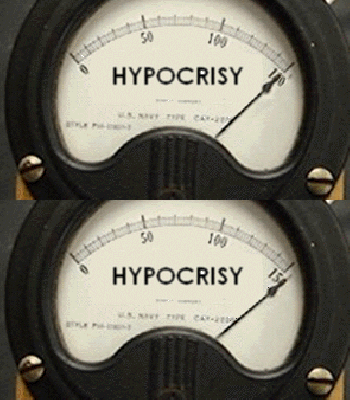
Blackvegatble's hypcorisy summed up in one post:
[/size]
Blackvegetable » 7 minutes ago » wrote: ↑7 minutes ago
Very simple questions...
From which you are running...
Blackvegetable » 7 minutes ago » wrote: ↑7 minutes ago
Very simple questions...
From which you are running...
4 posts • Page 1 of 1
Who is online
In total there are 3541 users online :: 6 registered, 11 bots, and 3524 guests
Bots: ADmantX, LCC, facebookexternalhit, proximic, Googlebot, NING, CriteoBot, Applebot, curl/7, Mediapartners-Google, bingbot