Liberal Forum
Archive
‹
Political Chat Rooms
‹
No Holds Barred Political Forum
‹
Maine Tells Grifty To Take a Hike...
Maine Tells Grifty To Take a Hike...

By R. Suave
28 Dec 2023 7:37 pm in No Holds Barred Political Forum

29 Dec 2023 9:07 am

You lied about the majority. And I corrected my error on my own. Wanna see?R.Suave » 29 Dec 2023, 10:03 am » wrote: ↑ I love the retelling..
You lied, remember?
And now you're doubling up.
Because you're a zerointegrity ballgummer.
BV is in question time out indefinitely, until he takes the pledge to answer questions one for one.
The Pledge viewtopic.php?f=3&t=100927
Popular Vote Totals 2024 viewtopic.php?p=2685476#p2685476
BV's Sporter Losshttps: viewtopic.php?p=2610828#p2610828
BV 33 miles: viewtopic.php?p=2747521#p2747521
Sources viewtopic.php?p=2589152#p2589152
The Pledge viewtopic.php?f=3&t=100927
Popular Vote Totals 2024 viewtopic.php?p=2685476#p2685476
BV's Sporter Losshttps: viewtopic.php?p=2610828#p2610828
BV 33 miles: viewtopic.php?p=2747521#p2747521
Sources viewtopic.php?p=2589152#p2589152

29 Dec 2023 9:09 am
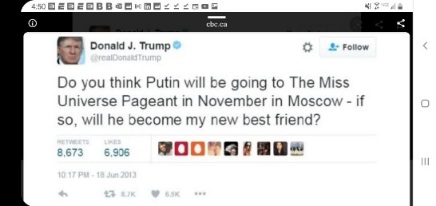
Hey Dickhead # 1
You're spinning your wheels here...you have serious credibility issues that just don't get up and go away


29 Dec 2023 9:10 am
https://www.npr.org/2021/02/10/96639684 ... ment-trialR.Suave » 29 Dec 2023, 9:39 am » wrote: ↑ Except that it was REPUBLICANS in Colorado who successfully sued to get Grifty disqualified.
There's the whole truth.
Trump clearly puts into context what he means by the term "FIGHTING" as in "fighting for what's right and being heard".

29 Dec 2023 9:13 am
Right, they must know they will get laughed out of (the supreme) court, they just want to keep the TDS going but it will backfire, it will only make Trump more popular...Majik » 29 Dec 2023, 8:03 am » wrote: ↑ Only if the SCOTUS rules it was an insurrection ....
And they won't .....
Because it was not an insurrection ....
Bellows like so many other Democrats are now grasping at straws out of fear of losing their grip on power.
They know that a reckoning will occur if Trump wins in 2024.
when they do stupid **** like this it shows America just how fragile the Dems see them selves as ......
and it feeds Trump's popularity among American's ....
Bellows gleefully tells MSDNC "I could not, unfortunately—or fortunately—wait for the Supreme Court to make a decision."

https://youtu.be/zXFg13VunKM
In memory of Pumpkins

29 Dec 2023 9:20 am
How much of the Jan 6 Hearings did you watch?GHETTOBLASTER » 29 Dec 2023, 10:10 am » wrote: ↑ https://www.npr.org/2021/02/10/96639684 ... ment-trial
There's the whole truth.
Trump clearly puts into context what he means by the term "FIGHTING" as in "fighting for what's right and being heard".
29 Dec 2023 9:22 am
The first "Republican" on your list is Claudine Schneider who voted for Obama, Hillary and Biden.R.Suave » 29 Dec 2023, 9:39 am » wrote: ↑ Except that it was REPUBLICANS in Colorado who successfully sued to get Grifty disqualified.
She's about as much of a Republican as other well known Frauds like Rachel "make believe negro" Dolezal and also Liz "make believe Indian" Warren .
I knew with 100% certainty that if I spent 2 minutes researching your claim that I would prove it to be fraudulent at it's very core.

29 Dec 2023 9:22 am
The part where Trump attacked two secret service guys and then threw his hamburger against the wall was particularly entertaining.

The powers not delegated to the United States by the Constitution, nor prohibited by it to the States, are reserved to the States respectively, or to the people
29 Dec 2023 9:24 am
Majik » 29 Dec 2023, 8:03 am » wrote: ↑ Only if the SCOTUS rules it was an insurrection ....
And they won't .....
Because it was not an insurrection ....
Bellows like so many other Democrats are now grasping at straws out of fear of losing their grip on power.
They know that a reckoning will occur if Trump wins in 2024.
when they do stupid **** like this it shows America just how fragile the Dems see them selves as ......
and it feeds Trump's popularity among American's ....
The appeal can't relitigate the finding of fact, it can only consider whether the law in Colorado provides insufficient Due Process to disqualify.Only if the SCOTUS rules it was an insurrection .
29 Dec 2023 9:25 am
There was no attempt or instructions to overthrow the US Government.
No self respecting man would buy into such ridiculousness
https://www.npr.org/2021/02/10/96639684 ... ment-trial
29 Dec 2023 9:25 am
You only heard about it.RedheadedStranger » 29 Dec 2023, 10:22 am » wrote: ↑ The part where Trump attacked two secret service guys and then threw his hamburger against the wall was particularly entertaining.
Then you were promised that it would be contradicted under oath.
Do you recall what happened next?
29 Dec 2023 9:26 am
That's not for you to assert.GHETTOBLASTER » 29 Dec 2023, 10:25 am » wrote: ↑ There was no attempt to overthrow the US Government.
No self respecting man would buy into such ridiculousness
29 Dec 2023 9:27 am
Name 3 "authentic" Republicans.GHETTOBLASTER » 29 Dec 2023, 10:22 am » wrote: ↑ The first "Republican" on your list is Claudine Schneider who voted for Obama, Hillary and Biden.
She's about as much of a Republican as other well known Frauds like Rachel "make believe negro" Dolezal and also Liz "make believe Indian" Warren .
I knew with 100% certainty that if I spent 2 minutes researching your claim that I would prove it to be fraudulent at it's very core.
29 Dec 2023 9:27 am
There was no attempt or instructions to overthrow the US Government.R.Suave » 29 Dec 2023, 10:25 am » wrote: ↑ You only heard about it.
Then you were promised that it would be contradicted under oath.
Do you recall what happened next?
No self respecting man would buy into such ridiculousness
https://www.npr.org/2021/02/10/96639684 ... ment-trial
29 Dec 2023 9:28 am
You're rebleating yourself.GHETTOBLASTER » 29 Dec 2023, 10:27 am » wrote: ↑ There was no attempt or instructions to overthrow the US Government.
No self respecting man would buy into such ridiculousness
https://www.npr.org/2021/02/10/96639684 ... ment-trial
You must be sublimating...
29 Dec 2023 9:28 am
GHETTOBLASTER » 6 minutes ago » wrote: ↑
6 minutes ago
The first "Republican" on your list is Claudine Schneider who voted for Obama, Hillary and Biden.
She's about as much of a Republican as other well known Frauds like Rachel "make believe negro" Dolezal and also Liz "make believe Indian" Warren .
I knew with 100% certainty that if I spent 2 minutes researching your claim that I would prove it to be fraudulent at it's very core.
29 Dec 2023 9:29 am
No answer.GHETTOBLASTER » 29 Dec 2023, 10:28 am » wrote: ↑ GHETTOBLASTER » 6 minutes ago » wrote: ↑
6 minutes ago
The first "Republican" on your list is Claudine Schneider who voted for Obama, Hillary and Biden.
She's about as much of a Republican as other well known Frauds like Rachel "make believe negro" Dolezal and also Liz "make believe Indian" Warren .
I knew with 100% certainty that if I spent 2 minutes researching your claim that I would prove it to be fraudulent at it's very core.
29 Dec 2023 9:29 am
GHETTOBLASTER » 1 minute ago » wrote: ↑
1 minute ago
There was no attempt or instructions to overthrow the US Government.
No self respecting man would buy into such ridiculousness
https://www.npr.org/2021/02/10/96639684 ... ment-trial
29 Dec 2023 9:30 am
GHETTOBLASTER » 1 minute ago » wrote: ↑
1 minute ago
GHETTOBLASTER » 6 minutes ago » wrote: ↑
6 minutes ago
The first "Republican" on your list is Claudine Schneider who voted for Obama, Hillary and Biden.
She's about as much of a Republican as other well known Frauds like Rachel "make believe negro" Dolezal and also Liz "make believe Indian" Warren .
I knew with 100% certainty that if I spent 2 minutes researching your claim that I would prove it to be fraudulent at it's very core.
29 Dec 2023 9:31 am
That's why you won't tell me what you challenge.nefarious101 » 29 Dec 2023, 10:09 am » wrote: ↑ Hey Dickhead # 1
You're spinning your wheels here...you have serious credibility issues that just don't get up and go away

29 Dec 2023 9:34 am

I have heard several;R.Suave » 29 Dec 2023, 10:02 am » wrote: ↑ What "constitutional issue" is involved in the Colorado decision?
Does double jeopardy apply? Article I, Section 3 states (in part); "Judgment in cases of impeachment shall not extend further than to removal from office, and disqualification to hold and enjoy any office of honor, trust or profit under the United States: but the party convicted shall nevertheless be liable and subject to indictment, trial, judgment and punishment, according to law." Remember, Trump was impeached for actions surrounding J6. The "experts" I have heard and read point out that a Senate conviction does not preclude another trial but the Constitution doesn't address if an acquittal precludes further legal action. Their position is, since there is nothing specific, we should look to normal trials for other matters. In those, an acquittal on a charge precludes further prosecution because of the double jeopardy prohibition. I think this is, by far, the weakest question.
Must "due process" be followed? Since a freedom/right is being taken, the due process provision (also in the 14th Amendment) must be followed. That would require a indictment and trial. A court, or attorneys, do not have the authority to conduct criminal investigations. The use of the word "criminal" comes from the next issue that has been offered.
Must someone be charged, tried and convicted before they can be disqualified? Section 5 of the 14th Amendment states: "The Congress shall have power to enforce, by appropriate legislation, the provisions of this article." Congress has addressed, by appropriate legislation, what constitutes insurrection when they passed legislation making it part of the US Criminal Code. The position of some "experts" is that, since there is a clear definition of insurrection in the US Criminal Code, a conviction is required before someone can be disqualified.
Does a state court have the authority to disqualify someone? Article III, Section 2 states (in part): " In all cases affecting ambassadors, other public ministers and consuls, and those in which a state shall be party, the Supreme Court shall have original jurisdiction." Their contention is that since the Constitution give the Supreme Court original jurisdiction (because a state is clearly a party), they are the ones that must make the determination.
Is the President an "officer of the United States"? Article II, Section 2 (Presidential Power) states: "... and by and with the advice and consent of the Senate, shall appoint ambassadors, other public ministers and consuls, judges of the Supreme Court, and all other officers of the United States, whose appointments are not herein otherwise provided for,..." Their position is that "officers of the United States" are appointed, not elected. They feel the use of the term "appoint", a partial list of specific officers, and the phrase "and all other officers" make it clear the President is not an officer. They support that position further by pointing out nowhere in the Constitution is the President referred to as "Chief Executive". Article II, Section 1 only states; "The executive power shall be vested in a President of the United States of America."
There may be others, but these are the issues I have heard.
Who is online
In total there are 7706 users online :: 14 registered, 17 bots, and 7675 guests
Registered users: Johnny You, Blackvegetable, Zeets2, Buck Naked, ROG62, ConservativeWave, Beekeeper, jerra b, SouthernFried, Funny Guy, Cannonpointer, nefarious101, sole, Huey
Bots: Baiduspider, SiteLockSpider, Bolt, LCC, Not, TTD-Content, MicroMessenger, ADmantX, proximic, YandexBot, Googlebot, Applebot, facebookexternalhit, curl/7, Mediapartners-Google, bingbot, CriteoBot