
11 May 2019 12:37 pm
This is the last time I will respond to that **** lie.Termin8tor » 11 May 2019 9:38 am » wrote:You accused me of lying when I noted that it is illegal to release the full Mueller Report, as Nadler is demanding.Under Federal Rule of Criminal Procedure 6(e) — passed by Congress — it is illegal to release grand-jury materials except for a specified list of purposes, and congressional investigations do not appear on this list.
https://www.nationalreview.com/2019/05/ ... s-general/
Nadler is NOT asking Barr to illegally release grand jury material without first obtaining a court order.
On May 8th the Judiciary Committee adopted an amendment proposed by Republican Matt Gaetz of Florida codifying that.
I provided you with the proof of that in my Giggles thread.
Yet you continue to lie about it.
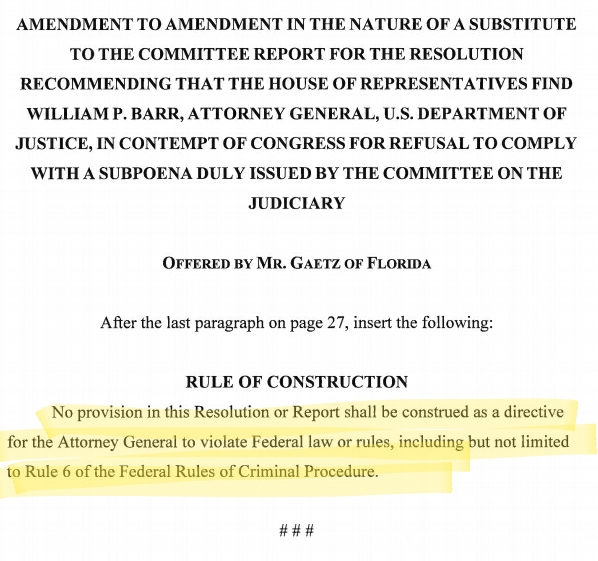
https://judiciary.house.gov/legislation ... -william-p
The Nixon impeachment hearings were considered a judicial proceeding, so Barr may be forcing Nadler's hand to open impeachment hearings in order to obtain the 6 (e) material.In Haldeman V Sirica the D.C. Circuit ruled that the district court judge, Judge John Sirica, “ha[d] dealt at length with” the grand-jury-disclosure question and that the D.C. Circuit was “in general agreement with his handling of [the] matter.”
Judge Sirica, for his part, held that district courts have inherent authority to release grand jury materials.
Also, in a recent case on this issue (McKeever V Barr) the majority said that in its view, the disclosure in Haldeman was made pursuant to the Rule 6 exception that permits district court judges to release grand jury materials “preliminarily to or in connection with a judicial proceeding."
https://www.theusconstitution.org/news/ ... er-report/
The “judicial proceedings” exception came into play the two times in the 20th century a sitting president was subject to independent investigation.
The first time was in the 1970s, when Watergate Special Prosecutor Leon Jaworski sent his “Road Map” of President Richard Nixon’s involvement in Watergate to Congress.
The second time was in the 1990s, when Independent Counsel Ken Starr delivered his report on President Bill Clinton’s misconduct to Congress.
It could come into play again soon, if the House Judiciary Committee petitions Chief Judge Beryl Howell of the D.C. federal court for access to Mueller’s grand jury material. (Judge Howell has been presiding over all legal matters arising from Mueller’s grand jury.)
In 1974, Jaworski’s team argued that the disclosure was permissible under Rule 6(e) because the Judiciary Committee’s impeachment inquiry was equivalent to a judicial proceeding.
Chief Judge John Sirica, Howell’s predecessor, allowed the disclosure.
Some might argue that for Congress to access grand jury material under the judicial proceedings exception, it must have a formal impeachment inquiry underway.
But that argument overlooks another key historical precedent: the Starr Report. Starr got judicial approval, using the judicial proceedings exception, to send his report to the House Judiciary Committee BEFORE the committee had done any investigation of its own into Clinton’s alleged wrongdoing.
In fact, it was the Starr Report itself that eventually prompted impeachment proceedings for Clinton.
Even more telling, the judicial proceedings exception allowed the final report on the Iran-Contra investigation to reach the public in 1994.
Obviously, the court of public opinion is not a “judicial proceeding,” but the D.C. federal appeals court didn’t let that stand in the way of the enormous public interest in the investigation’s findings.
The court concluded that its own adjudication of whether to release the report constituted the “judicial proceeding” required by the rule.
Here, the House Judiciary Committee is exercising its constitutional authority to investigate allegations of the Trump administration’s obstruction of justice and other abuses of power.
It launched its investigation on March 4, and authorized a subpoena for the full Mueller report on April 3.
The full House of Representatives, moreover, has passed a resolution 420-0 calling on the Justice Department to make Mueller’s complete report available to Congress.
The constitutional imperatives are clear.
https://www.politico.com/magazine/story ... ort-226577